Table of Contents
Choosing between fresh lead data vs static lead databases depends on what your local prospecting campaign actually needs.
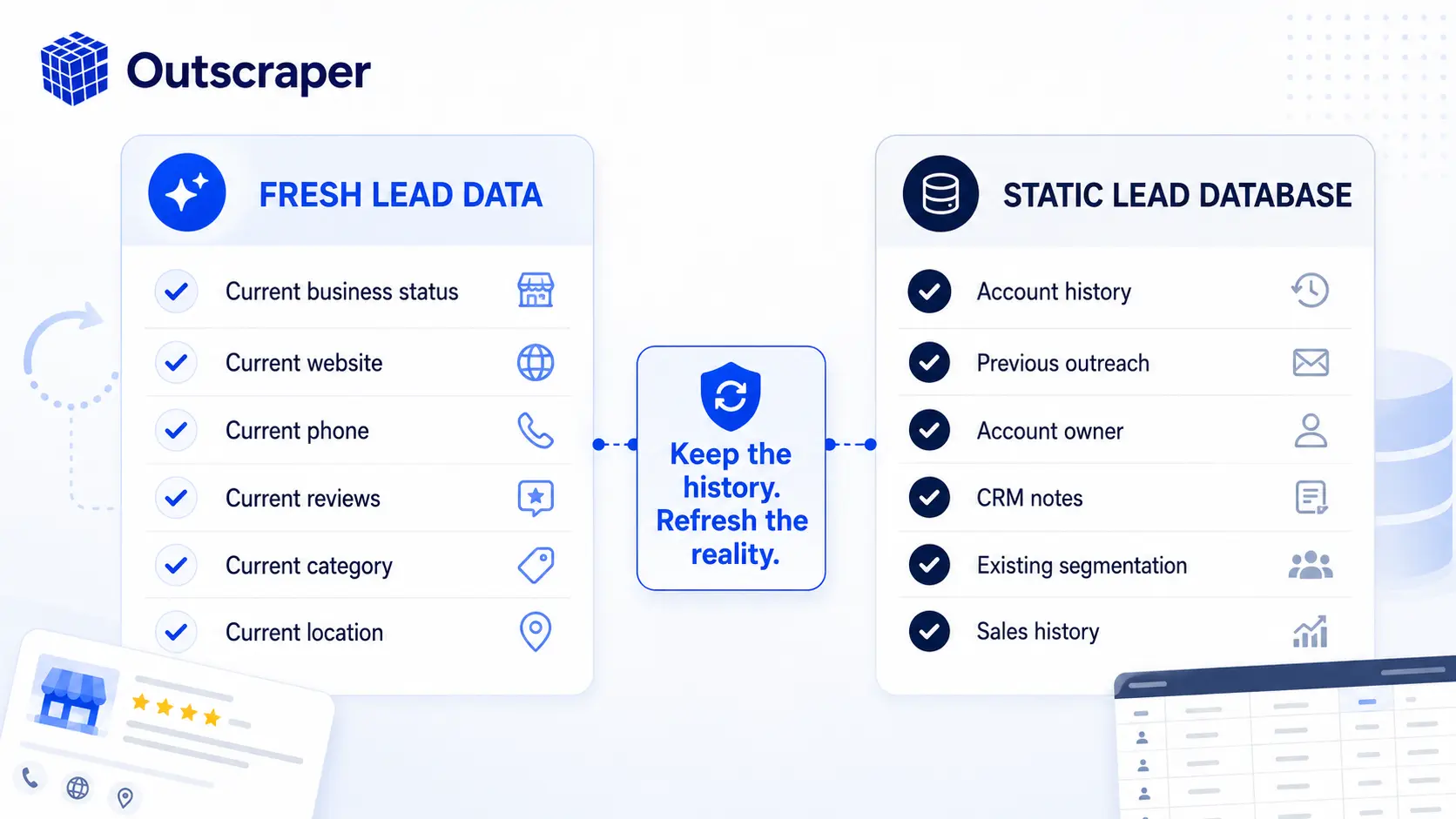
Fresh lead data is usually more useful when targeting depends on current business information such as location, category, website status, phone number, reviews, ratings, or whether a business is still operating. A static lead database is more useful when your team needs account history, ownership, previous outreach, segmentation, and long-term CRM continuity.
For many sales teams, the best option is not replacing one with the other. It is keeping the valuable history already stored in the database while refreshing the business information that can change before the next campaign.
Quick Answer: Fresh Lead Data vs. Static Lead Databases
Use fresh lead data when current business conditions affect who should be contacted. Use a static lead database when historical sales context and account continuity matter. For many local prospecting workflows, the best approach is to preserve the existing database while refreshing current business information before qualification and outreach.
In simple terms:
Static databases preserve the history. Fresh business data verifies the current reality.
What Is the Difference Between Fresh Lead Data and a Static Lead Database?
Fresh lead data is business information collected or refreshed close to the time a sales or marketing team plans to use it. For local prospecting, this may include business name, category, location, website, phone number, rating, review count, operating status, opening hours, and other public business details.
The important point is not that every field changes every day. The value comes from checking the fields that can materially affect targeting before outreach begins.
Static Databases Preserve Sales Context
A static lead database is different. It is an existing collection of business or prospect records that a team maintains over time, usually inside a CRM, spreadsheet, sales platform, or internal database. Those records can contain account ownership, previous conversations, opportunity history, sales notes, internal segmentation, campaign history, and other context that fresh discovery data does not automatically provide.
However, that makes neither approach universally better.
A static database is strong at preserving continuity. Fresh data is strong at reflecting current business conditions.
| Comparison | Fresh Lead Data | Static Lead Database |
|---|---|---|
| Recency | Better for current business information | Depends on last update |
| New business discovery | Strong | Limited to stored records |
| Business status | Better for current verification | May become outdated |
| Website and phone | Can reflect newer public information | Can become stale |
| Ratings and reviews | Useful for current qualification | Often an older snapshot |
| Sales history | Usually limited | Strong |
| Account ownership | Must be matched or added | Usually preserved |
| Previous outreach | Usually unavailable | Preserved |
| Best use | Discovery, validation, refresh | CRM continuity and account history |
Outscraper’s Google Maps Scraper can collect structured public business information such as business names, phone numbers, websites, ratings, reviews, categories, and location data.
When Should You Use Fresh Lead Data?
Fresh business data becomes more valuable when changing business conditions directly affect whether a company should receive outreach.
Current Status, Location, or Category Matters
Local businesses open, close, relocate, expand, and update their public information. If a campaign targets a specific city, territory, radius, or business category, current business information can prevent time being spent on companies that no longer fit.
Google also recommends keeping business information accurate and up to date because details such as address, hours, and contact information can change over time.
Website, Reviews, or Ratings Affect Qualification
Suppose a web design agency targets businesses without websites. A company on an older list may have launched a website since the record was created.
The same issue applies to reviews and ratings. A reputation-management campaign based on review count or rating needs those signals to be recent enough to support the targeting rule.
You Need Current Market Coverage
An existing CRM only shows the businesses already stored in it. It does not automatically include companies that opened later or businesses that were never added.
If the objective is to prospect an entire local category or territory, fresh discovery becomes more useful.
If your targeting depends on current business category, location, website, phone, ratings, reviews, or other public listing information, use Outscraper’s Google Maps Scraper to collect or refresh the business records needed for the campaign.

When Does a Static Lead Database Make More Sense?
A good static database should not be discarded simply because some public business fields can become outdated.
Static databases are particularly valuable when the sales process depends on known accounts, previous outreach, internal segmentation, account ownership, or historical context.
Known Accounts and Previous Outreach
A sales team may already have a defined set of strategic accounts with assigned representatives, previous conversations, opportunities, and internal notes.
That history matters.
Fresh business discovery can verify what is happening with the business now, but it does not automatically know that another salesperson contacted the account three months ago or that a previous opportunity was lost.
CRM History and Internal Segmentation
Accounts may already be organized by territory, account value, lifecycle stage, customer type, or internal priority.
Those fields do not become useless just because the business phone number, website, or location changes.
In these situations, the existing database should remain the foundation. Refresh the fields that can become stale rather than rebuilding everything.
Why Local Prospecting Often Needs Both
Local prospecting frequently depends on information that changes over time, but it also benefits from historical sales context.
That makes the fresh-versus-static decision less binary than it first appears.
A restaurant may close while the account history remains valuable. A contractor may launch a new website while previous outreach still matters. A clinic may move while the sales rep assigned to the account remains the same.
This creates two separate questions:
What does our team already know about this account?
and:
What appears to be true about the business now?
In practice, a static database answers the first question better.
Fresh business data helps answer the second.
However, freshness should not be confused with qualification. A recently collected business record is not automatically a good lead. Fresh data tells you whether the information is current enough to evaluate. Qualification determines whether the business actually fits the campaign.
That distinction is important because a fresh dataset can still contain thousands of irrelevant records.
The Best Workflow: Refresh, Qualify, Enrich, and Outreach
For many sales teams, the strongest workflow is to use the existing database as the foundation and refresh the business fields that affect current targeting.
A practical sequence is:
Existing database → refresh business facts → qualify → enrich selected prospects → update CRM → outreach
Keep the Sales Context
Preserve account IDs, ownership, previous conversations, sales notes, lifecycle stages, opportunity history, and internal segmentation.
Refresh What Can Change
Update the business facts that influence current prospecting, such as business status, location, category, website, phone number, rating, review count, and other relevant public information.
For teams working with existing CRM data, Outscraper has a separate guide on enhancing CRM records with automated company data enrichment. Outscraper describes CRM enrichment as updating and enhancing existing records with missing information rather than rebuilding the CRM from scratch.
Qualify Before You Enrich
Once the current business information is available, apply the targeting criteria again.
Some businesses will still fit the campaign. Others may no longer qualify, while stronger prospects may still need additional contact information before outreach.
That is when enrichment becomes useful.
For a deeper explanation, see How Outscraper’s Leads & Contacts Enrichment Works. Outscraper’s enrichment workflow is designed to update and expand lead and contact records without requiring manual research for each record.
Outscraper also allows its Google Maps Scraper to be paired with Emails & Contacts Scraper when additional contact information is needed.
The practical order is:
Extract or refresh → qualify → enrich → CRM → outreach
This prevents teams from spending enrichment resources on records that should have been removed earlier.

Example: Refreshing an Older Local Prospect List
Suppose a marketing agency has a database of 3,000 home-service businesses collected one year ago.
Then, the team can compare the current business information with its existing sales history.
First, verify whether the businesses still appear operational and remain in the correct markets and categories. Then update website and public phone information. If ratings or reviews are part of the qualification criteria, refresh those fields as well.
The team can then compare the current business information with its existing sales history.
Some businesses will remain strong prospects. Others may no longer fit. Some may need contact enrichment before outreach. New businesses discovered in the market can be added without removing the history attached to existing accounts.
This gives the team better current information without forcing it to rebuild its entire prospecting system.
Choose the Right Data Strategy for Local Prospecting
There is no universal winner in fresh lead data vs static lead databases.
Static databases provide continuity by preserving account ownership, previous conversations, internal segmentation, and sales history. Fresh business data provides a more current view of the business conditions that can influence targeting.
For many local prospecting teams, the strongest approach is:
Preserve the history → refresh current business facts → qualify → enrich → outreach.
If the existing database contains useful sales context, keep it and refresh the fields that can change. If the team is entering a new market or needs businesses that are not already in the database, begin with current business discovery.
Frequently Asked Questions
Most frequent questions and answers
Fresh lead data is collected or refreshed close to the time it will be used, making it more useful for current information such as location, website, phone number, ratings, reviews, and business status. A static lead database is better at preserving account history, ownership, segmentation, previous outreach, and other long-term sales context.
No. Fresh lead data is more useful when current business conditions affect qualification. A static database can be more useful when historical sales information and account continuity are important. Many local prospecting workflows benefit from combining both.
There is no single refresh schedule that works for every campaign. Refresh the fields that matter when there is a reasonable chance they have changed enough to affect targeting. Campaigns based on business status, website presence, location, contact information, ratings, or reviews generally benefit from checking those fields before outreach.
Usually not. Your CRM may contain valuable account ownership, previous conversations, lifecycle stages, notes, and sales history. A better approach is often to preserve those records and update the public business fields that influence the current campaign.
Yes. Current business information can be used to verify or update existing records and can then be matched back into the CRM or lead database. Outscraper also provides enrichment workflows designed to update and expand existing business and contact records.
No. Freshness tells you that the information is more current. Qualification determines whether the business matches your category, market, service, contactability, or other campaign requirements.
Lead enrichment should generally happen after the underlying businesses have been refreshed or collected and the obvious mismatches have been removed. This allows your team to spend enrichment effort on stronger prospects instead of enriching every raw record.
For teams that already have a useful database, a practical workflow is:
Existing database → refresh current business facts → qualify → enrich selected prospects → update CRM → outreach.
Keep the account history and sales context already in your database while updating the business information that can change before outreach. Use Outscraper to refresh current local business data, qualify the records that still fit, and enrich stronger prospects before moving them back into your sales workflow.