Índice
Many local businesses without websites are still active, reviewedy easy to find on Google Maps. They may have a working phone number, busy opening hours, and strong customer reviews, but no dedicated website listed.
This website gap matters because it can show where agencies, freelancers, sales teams, and market researchers may find clear business opportunities.
The best prospects are not always businesses with no online presence. A stronger signal is an active business with reviews, a phone number, a clear category, and no website field.
This article looks at 12 local industries where missing websites are still common in 2026 and how to spot them using public business data.
Quick answers:
- Local businesses without websites may appear on Google Maps, social media, directories, or booking platforms, but have no dedicated website listed.
- Common industries include home services, contractors, cleaning services, salons, childcare centers, pet services, event services, and local professional services.
- Missing website data works best as a prospecting signal when paired with ratings, reviews, phone numbers, categories, opening hours, and business status.
- Outscraper can help collect Google Maps business data by category and location, then filter records where the website field is empty.
The Quick Field Check: How to Spot Local Businesses Without Websites
Do not treat every blank website field as a good opportunity.
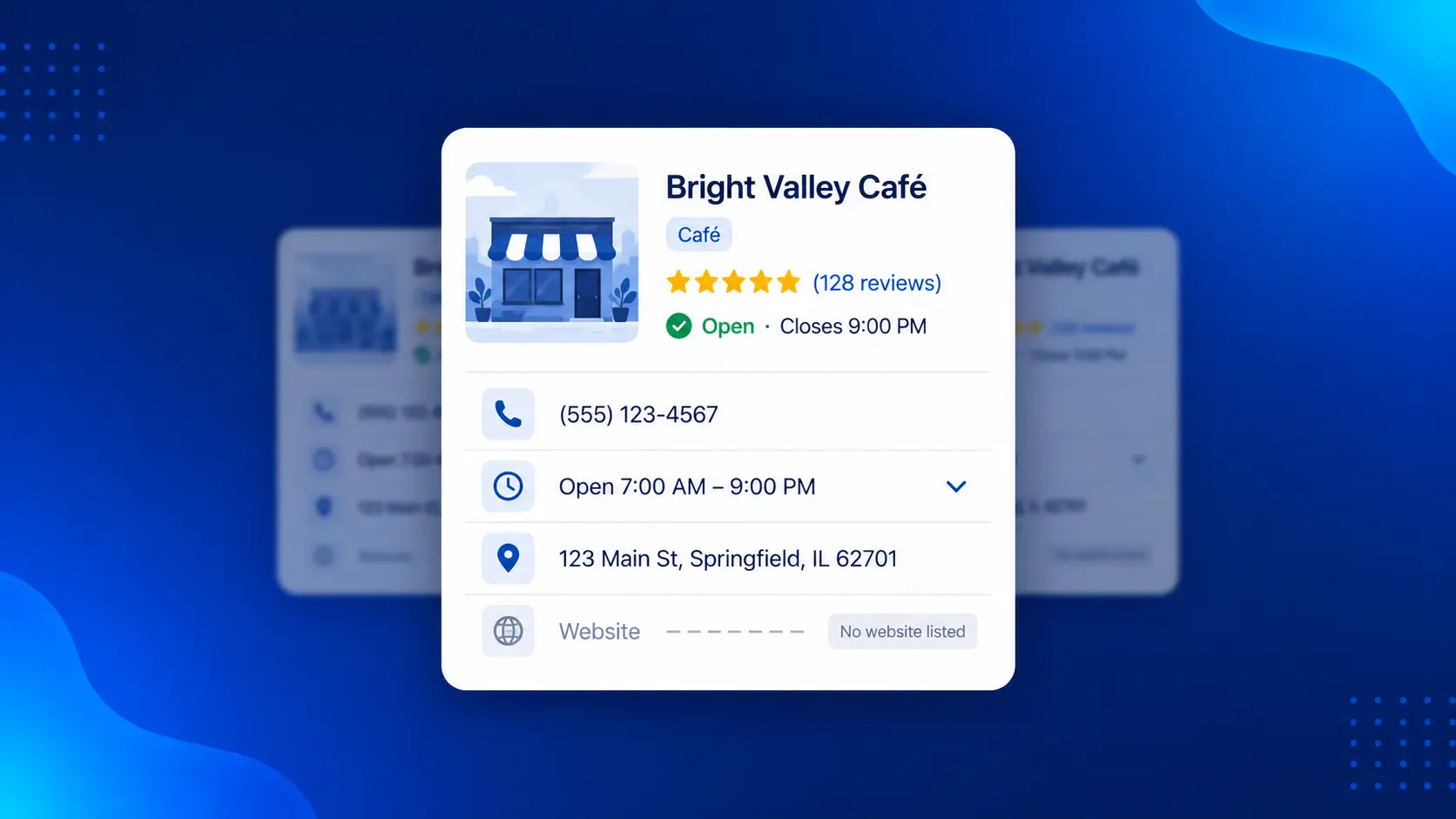
A business with an empty website field, no reviews, no phone number, and unclear details may not be worth adding to your list. A better prospect is an active business with a clear category, working phone number, customer reviews, and no dedicated website listed.
That difference matters.
For example, a roofing contractor company in San Diego, California, with 90 reviews, a 4.7-star rating, active hours, and no listed website may be a better lead than a business with no website and no signs of activity.
Use this quick field check before building your shortlist:
| Field to Check | What It Tells You | Why It Matters |
|---|---|---|
| Website field | Whether the business has a website listed | This is the main gap you are checking |
| Business category | What service the business offers | Helps group prospects by industry |
| Phone number | Whether the business is reachable | A reachable business is easier to contact |
| Clasificación | How customers view the business | Strong ratings can show trust |
| Review count | How active or known the business is | More reviews can show demand |
| Opening hours | Whether the business appears active | Active hours help filter out weak records |
| Business status | Whether the listing is open or closed | Closed businesses should be removed |
| Location or service area | Where the business operates | Helps sort by city, region, or territory |
The strongest signal is not the blank website field alone.
The stronger signal is:
Active business + clear category + phone number + reviews + missing website field.
This is where public business data becomes useful. With the El Scraping de Google Maps, you can collect business records by category and location, then filter the results by missing website fields.
For agencies, this can help find web design or local SEO prospects. For sales teams, it can help find businesses that may need booking tools, quote forms, CRMs, or better contact pages. For market researchers, it can help compare how many businesses in a category still depend on Google Maps, social media, directories, or booking platforms en lugar de their own websites.
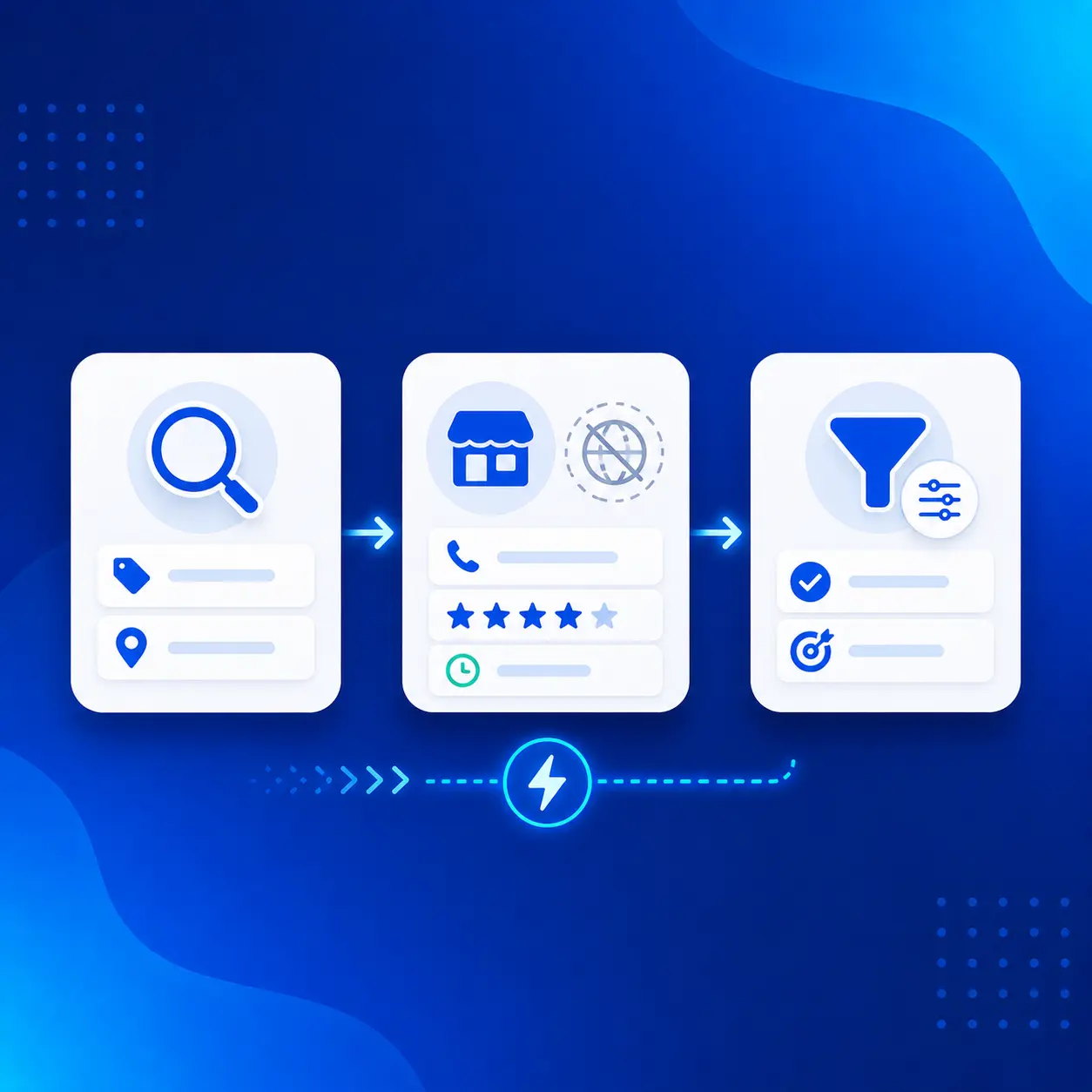
Use Outscraper to search by business category and location, then filter for active businesses with missing website fields, phone numbers, reviews, and other useful lead signals.
12 Industries to Check First for Website Gaps
Missing websites are often easier to find in service-based, referral-driven, and owner-operated industries. Many of these businesses are still active. They may have reviews, phone numbers, photos, opening hours, and steady demand, but no dedicated website is listed.
Recent small business surveys still show that website ownership is not universal. Clutch reports that 83% of small businesses have a website, which means 17% still do not. CFIB also found that 78% of Canadian small businesses have a company website, while many also use Facebook, Google Business Profile/Maps, and Instagram to connect with customers.
Exact numbers vary by country, source, and definition, but the pattern is clear: many small businesses are online in some way without always relying on a dedicated website.
This list is not a ranking of industries with the highest exact website-missing rate. It is a practical starting point based on local service patterns, common prospecting use cases, and fields that can be checked in Google Maps business data.
For broader local market research, teams can also use Google Maps data to compare categories, locations, ratings, review counts, and website availability.
Use the industries below as the first categories to check when building a shortlist.
1. Home Services and Trades
Examples include plumbers, electricians, HVAC companies, roofers, and handyman services. These businesses often depend on referrals, emergency calls, and Google Maps visibility.
Best signals: missing website field, strong reviews, phone number, active business status, and clear service category.
2. Construction and Contractors
Examples include general contractors, remodelers, painters, flooring contractors, and concrete contractors. Many contractors get work through referrals, subcontracting, and local networks.
Best signals: high-value service category, strong rating, project photos, phone number, and no dedicated website.
3. Landscaping and Lawn Care
Examples include lawn care, tree services, garden care, landscape maintenance, and seasonal services. Many small operators grow through recurring customers and local referrals.
Best signals: local service area, phone number, seasonal demand, nearby reviews, and missing website field.
4. Auto Repair and Body Shops
Examples include auto repair shops, tire shops, body shops, detailing services, and mobile mechanics. Some shops rely on repeat customers, walk-ins, and map visibility.
Best signals: many reviews, active hours, phone number, clear repair category, and no listed website.
5. Cleaning Services
Examples include home cleaning, office cleaning, carpet cleaning, window cleaning, and move-out cleaning. Many small cleaning teams start through referrals, local groups, and property managers.
Best signals: service area, phone number, local reviews, clear cleaning category, and missing website field.
6. Barbers, Salons, and Personal Care
Examples include barbershops, hair salons, nail salons, spas, and massage studios. Many use Instagram, Facebook, or booking apps instead of a website.
Best signals: social-only presence, booking link, strong reviews, and customer photos.
7. Independent Restaurants and Food Businesses
Examples include local restaurants, cafes, bakeries, food trucks, and caterers. Some rely on Google Maps, delivery apps, social media, or third-party menu pages.
Best signals: no direct website, third-party menu links, delivery app dependence, active reviews, and recent photos.
8. Childcare and Daycare Centers
Examples include daycare centers, preschools, childcare providers, after-school programs, and learning centers. Parents often need more details before calling, so a missing website can create a trust gap.
Best signals: parent reviews, local address, phone number, active hours, and no dedicated website.
9. Pet Services
Examples include pet groomers, dog trainers, pet boarding, pet sitters, and mobile pet care services. Many providers use referrals, social media, and local reviews.
Best signals: pet owner reviews, photos, phone number, clear service category, and missing website field.
10. Fitness and Wellness Studios
Examples include yoga studios, Pilates studios, gyms, personal trainers, and wellness coaches. Some use booking platforms or Instagram instead of their own website.
Best signals: booking platform only, class-based category, reviews, active hours, and social-only presence.
11. Event Services
Examples include photographers, DJs, florists, caterers, and event planners. Many depend on referrals, Instagram portfolios, and marketplace profiles.
Best signals: strong reviews, missing portfolio, phone number, service photos, and no listed website.
12. Local Professional Services
Examples include accountants, attorneys, consultants, insurance agents, and tax preparers. Some solo or older practices still depend on referrals and client relationships.
Best signals: high-value service category, strong reviews, phone number, clear location, and no dedicated website.
Connect Outscraper with your lead generation process and collect fresh Google Maps data by category, location, website availability, business status, ratings, and reviews.
Why These Businesses Still Skip Dedicated Websites
Many local businesses without websites are not ignoring the internet. They may already get leads from Google Maps, referrals, social media, directories, or repeat customers.
For some owners, a website feels useful but not urgent. If the phone is still ringing, they may not feel the gap right away.
Here are the common reasons this still happens.
They Get Enough Work From Referrals
Many contractors, cleaners, repair shops, and personal care businesses grow through word of mouth. If past customers keep sending new customers, the owner may not see a website as a priority.
This is common in small local markets where trust is built through personal recommendations.
They Treat Google Business Profile as Enough
Some businesses already appear on Google Maps with their phone number, reviews, address, photos, and opening hours. From the owner’s point of view, that may feel like enough online presence.
The problem is that Google Business Profile does not fully replace a website. Customers may still want service pages, prices, booking options, menus, project samples, or detailed contact forms.
They Use Social Media Instead
Some businesses use popular social media websites or booking apps as their main online channel. This is common for salons, restaurants, fitness studios, pet services, and event providers.
Social media can help customers see updates and photos, but it is harder to organize service details, FAQs, locations, and contact options in one place.
They Are Too Busy With Daily Operations
Many local business owners handle sales, customer service, scheduling, staff, inventory, and fieldwork at the same time. Building a website can feel like another task that they do not have time to manage.
This is one reason active businesses can still have no website listed even when they have strong reviews and steady demand.
They Worry About Cost or Maintenance
Some owners think a website will be expensive, technical, or hard to update. Others may have had an old website before and let it expire because it was not maintained.
This can create a gap where the business is active offline and visible on Google Maps, but customers still cannot visit a dedicated website.
They Do Not See the Lost Opportunity
A business may already get calls, so the missing website does not feel like a problem. But customers comparing several options may choose the business with clearer service pages, pricing details, photos, trust signals, and booking steps.
This is why missing website data can be useful for agencies, sales teams, and researchers. It shows where a business may be visible, reachable, and active, but still missing a channel that customers often expect.
Website Gap Scorecard for 2026
Not every industry has the same level of website gap. Some categories are easier to check because the businesses are local, service-based, and reachable by phone. Others may already depend on booking platforms, social media pages, or third-party directories.
Use this scorecard as a simple way to compare where to start. The ratings are based on practical prospecting factors, not exact industry-wide website ownership percentages.
| Industry | Gap Likelihood | Outreach Potential | Best Signal to Check | Best Pitch Angle |
|---|---|---|---|---|
| Home services and trades | High | High | Reviews + phone number | More quote requests |
| Construction and contractors | High | High | Project photos + service category | Show past work and build trust |
| Landscaping and lawn care | High | Medium-High | Local service area + seasonal demand | Book recurring customers |
| Auto repair and body shops | Medium-High | Medium | Reviews + active hours | Help customers check services before calling |
| Cleaning services | High | High | Service area + phone number | Turn local demand into quote requests |
| Barbers, salons, and personal care | Medium | Medium | Social-only presence + booking link | Add service pages and booking details |
| Restaurants and food businesses | Medium | Medium | Third-party menu links | Own the menu and direct orders |
| Childcare and daycare centers | Medium-High | High | Parent reviews + local address | Build trust before parents call |
| Pet services | Medium-High | Medium-High | Reviews + photos | Show services, policies, and booking info |
| Fitness and wellness studios | Medium | Medium | Booking platform only | Own schedules, prices, and memberships |
| Event services | Medium-High | High | Service photos + missing portfolio | Show work, packages, and inquiry forms |
| Local professional services | Medium | High | High-value service + reviews | Build trust before consultation |
The same scorecard can also be viewed as an opportunity chart. The highest-scoring industries combine a likely website gap, strong outreach potential, and clear business signals that can be checked in public data.
This chart is not based on exact website-missing percentages by industry. Use it as a practical guide for choosing which categories to check first.
Highest Opportunity Industries to Check First
Opportunity score based on the scorecard above.
For example, a contractor with strong reviews, project photos, a working phone number, and no listed website may be a better lead than a listing with no signs of activity.
The goal is to find businesses that are already visible and reachable, but still missing a dedicated site for service pages, contact forms, booking steps, menus, project examples, or trust signals.
How to Build a Shortlist with Outscraper
After choosing the industries you want to check, the next step is to turn the idea into a clean prospect list or local business database.
You can do this manually by searching Google Maps one category and city at a time, but that quickly becomes slow. A faster way is to collect the business data in bulk, then filter it based on the fields that matter.
Here is a simple workflow:
- Choose a business category, such as plumbers, cleaning services, daycare centers, or pet groomers.
- Add the location you want to check, such as a city, region, state, or service area.
- Set the maximum results limit based on how large you want the list to be.
- Seleccione servicios de enriquecimiento if you need extra contact or business details.
- Open Advanced Parameters and apply quick filters such as Only Without website y la Operational only.
- Seleccione delete duplicates to reduce repeated listings.
- Use ZIP codes if you want broader or more structured location coverage.
- Click Get Data and review the results.
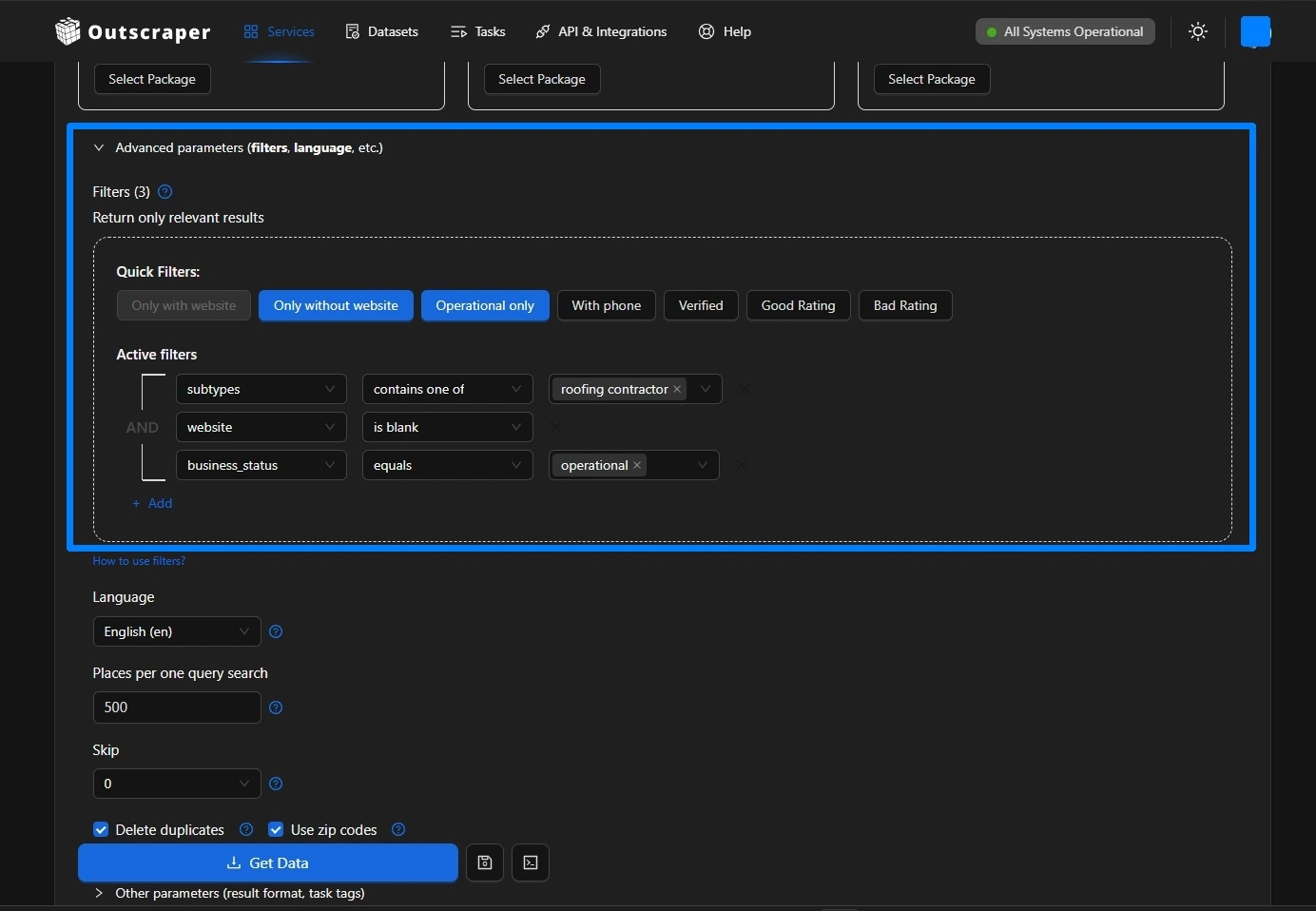
This gives you a more useful shortlist than a simple list of blank website fields. You can focus on active businesses that match your category, location, and website criteria before spending time on outreach or research.
For example, an agency can search for roofing contractors in San Diego, California, apply the Only Without website y la Operational only filters, remove duplicates, and then review businesses with ratings, reviews, phone numbers, and clear service categories.
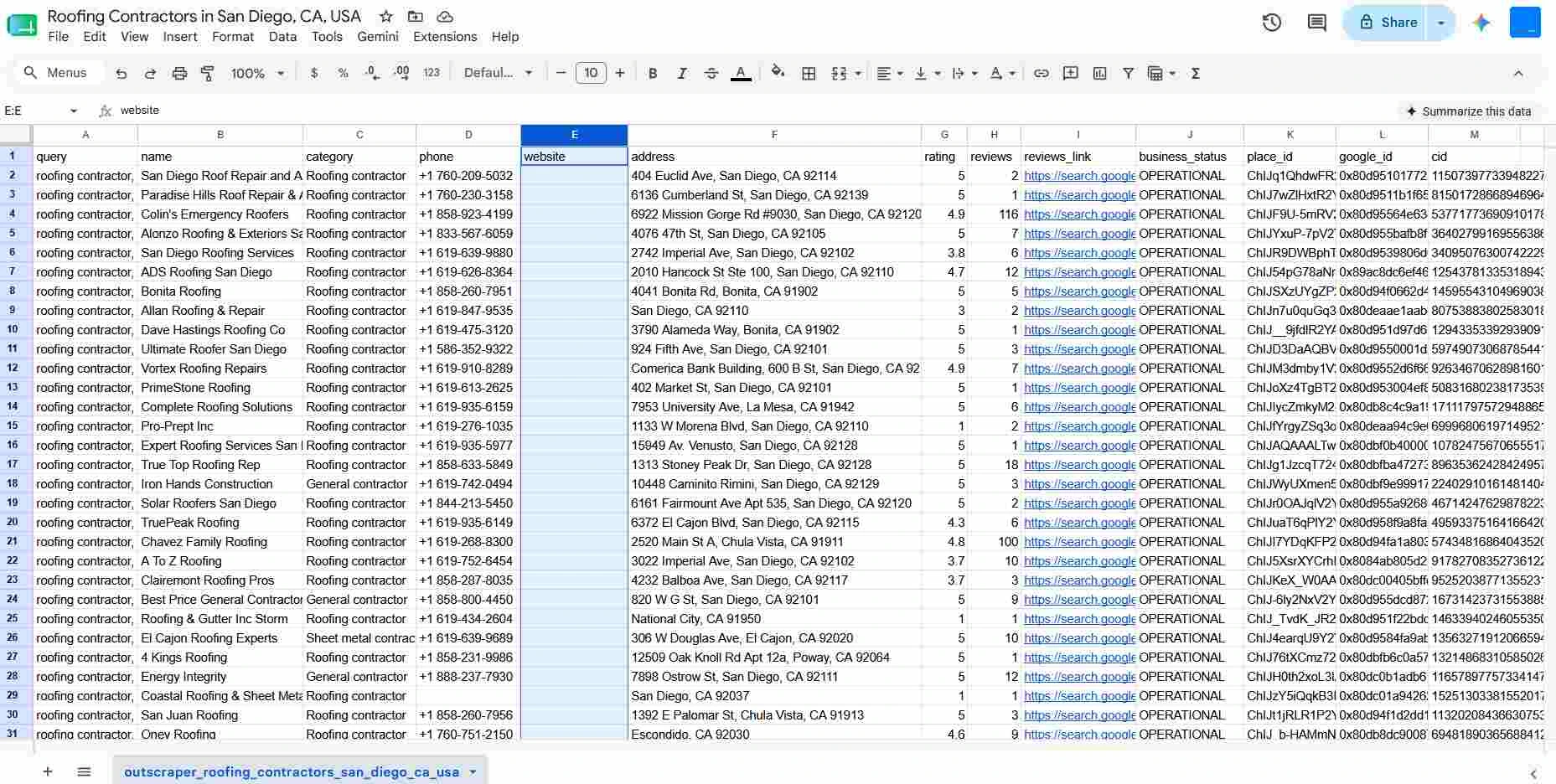
With Outscraper, teams can find website-gap prospects faster because the search, filters, and data fields are handled in one workflow instead of checking listings one by one.
Final Checklist for Finding Local Businesses Without Websites
Before outreach, check:
- Category and location match your target market.
- The website field is empty or missing.
- Business status is operational.
- Phone number, rating, and reviews are available.
- Duplicate listings are removed.
- The business has enough activity to be worth reviewing.
Use Outscraper to search by category and location, apply filters like Only Without website y la Operational only, remove duplicates, and build cleaner prospect lists from fresh Google Maps business data.
Preguntas más frecuentes
Preguntas y respuestas más frecuentes
Local businesses without websites are businesses that may appear on Google Maps, social media, directories, or booking platforms but do not have a dedicated website listed for customers to visit.
You can search by business category and location, collect business data, and filter records where the website field is missing. Then check ratings, reviews, phone numbers, opening hours, categories, and business status to find active businesses worth reviewing.
Industries to check first include home services, contractors, landscaping, auto repair, cleaning services, salons, childcare centers, pet services, fitness studios, event services, restaurants, and local professional services.
Social media pages can help, but they do not replace a business-owned website. A website gives customers a clearer place to check services, prices, locations, contact forms, menus, photos, booking steps, and trust signals.
Some small businesses rely on referrals, repeat customers, Google Maps, Facebook, Instagram, directories, or booking apps. Others avoid websites because of cost, time, maintenance, or lack of technical knowledge.
Sí. Missing website data can be useful for prospecting when it is paired with signs of activity, such as strong reviews, a working phone number, a clear service category, opening hours, and an active business status.
Check whether the business is active, reachable, and relevant to your offer. Look at its reviews, rating, phone number, category, photos, business status, service area, and whether it already uses social media or third-party booking links.