POI - Crucial Data for Location Intelligence Platforms
The global location intelligence market is projected to reach $53.63 billion in 2030.
Therefore, keeping points of interest fresh is an uphill challenge but is crucial for any location intelligence platform.
On the other hand, having fresh data is not enough without worldwide coverage of the POI.
Integrate the World’s Leading Sources of POI Into Your Platform
Whether you are looking to populate, update, or benchmark your platform’s dataset against top competition, Outscraper is an all-in-one solution. We focus on integrating top public sources of POI into customers’ platforms.
Since Google Maps is the very first stop for any new entrepreneur for promotion, it became a truly worldwide real-time POI database. Paired with other data sources it can fully fulfill your POI needs.
POI Delivery Options
Talk To Sales
Key Advantages of Using Outscraper for Location Intelligence
Understand What Surrounds Your Next Location
Say goodbye to sifting through irrelevant records and hello to efficient and effective datasets…
Outscraper allows you to easily retrieve only the Points of Interest (POI) data that you require. With its advanced filtering capabilities, you can target specific categories, locations, and other criteria to ensure that you receive the most relevant and valuable data for your business needs.

Outscraper services offer worldwide coverage for your POI data needs. Our advanced data scraping technology allows you to collect data from any country and city, without limitations.

Outscraper offers the largest number of fields available to compile and enrich your POI data. Check out the demo file to see the full range of fields available and visit the data dictionary to explore them.

Pay for only what you need, with no subscription fees and no big commitment upfront. Outscraper’s Preisgestaltung ist transparent und basiert auf dem von Ihnen erfassten Datenvolumen, so dass Sie den besten Gegenwert für Ihr Geld erhalten.

Häufig gestellte Fragen
Answers to common questions about using business and POI data for location intelligence.
What is the POI of a location?
The term “POI” stands for “Point of Interest.” When referring to the “POI of a location,” it typically means a specific point or place within a given location that is of particular interest or significance. This could be a landmark, facility, attraction, or any other notable spot.
Zum Beispiel:
- In a city, the POI could be a famous monument, a museum, a popular restaurant, or a historic site.
- In a national park, the POI could be a specific viewpoint, a waterfall, a trailhead, or a camping area.
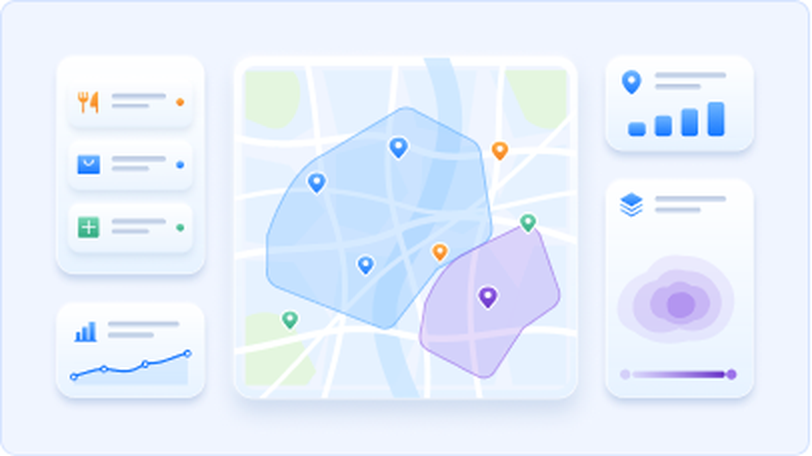
In the context of navigation and mapping, the POI of a location would be a specific point that users might want to visit or navigate to. It would typically be represented with a marker on a map and might include additional information like its name, description, and other relevant details.
What are the benefits of POI location data?
Here’s a concise version of the benefits of POI location data:
- Navigation: Guides users to specific destinations in GPS devices and apps.
- Benutzererfahrung: Helps users discover nearby services or attractions.
- Business Decisions: Assists in location-based decision-making for businesses.
- Marketing: Enables location-based promotional targeting.
- Stadtplanung: Informs infrastructure and public service development.
- Tourism: Recommends attractions and services to travelers.
- Immobilien: Provides insights on nearby amenities for buyers/renters.
- Emergency Response: Helps locate essential services quickly.
- Research: Aids in urban and socio-economic studies.
- Augmented Reality: Enhances real-world views with POI overlays.
In essence, POI data enhances navigation, decision-making, and user experiences across various sectors.
What does POI mean in maps?
In maps, “POI” stands for “Point of Interest.” It refers to specific locations or destinations on a map that might be of particular interest to users. POIs can include places like restaurants, gas stations, tourist attractions, hospitals, parks, and more. On digital maps or navigation systems, POIs are often represented by icons or markers, and users can select them to get more information or directions to that location.
Was sind Location-Intelligence-Daten?
Bei Location-Intelligence-Daten geht es um die Analyse geografischer oder räumlicher Daten, um Erkenntnisse für die Entscheidungsfindung zu gewinnen. Zu den wichtigsten Aspekten gehören:
- Datenquellen: GPS, Satellitenbilder, Volkszählungsdaten usw.
- Räumliche Analyse: Untersuchung von Mustern und Trends in geografischen Daten.
- Visualisierung: Verwendung von Tools wie GIS zur Darstellung von Daten auf Karten.
- Anwendungen:
- Unternehmen: Optimale Standorte für Filialen.
- Stadtplanung: Ausbau der Infrastruktur.
- Gesundheitswesen: Verfolgung von Krankheitsausbrüchen.
- Immobilien: Ermittlung von Immobilienwerten.
- Umwelt: Überwachung von Landnutzungsänderungen.
- Verkehr: Optimierung der Lieferrouten.
Im Wesentlichen hilft Location Intelligence dabei, fundierte Entscheidungen auf der Grundlage geografischer Daten zu treffen.
What is POI mapping?
POI mapping refers to the process of plotting and visualizing Points of Interest (POIs) on a map. These POIs can be any specific locations or destinations that might be of interest to users, such as restaurants, gas stations, tourist attractions, and more. In the context of digital maps or navigation systems, POIs are often represented by icons or markers, allowing users to easily identify and access information about these locations. The primary goal of POI mapping is to enhance the user’s understanding and navigation of an area by highlighting key places of interest.