Índice
Teams using AI in outreach are seeing better replies because AI can help qualify prospects, find outreach angles, and write messages faster. That is why ChatGPT gets so much attention in AI lead generation. But after testing it for real lead generation work, I found the part most guides skip. ChatGPT can score, group, and write from lead data. It cannot feed itself with fresh verified leads. When I asked it to work from a blank prompt, it sounded confident but became unreliable. When I gave it real business data, it became useful.
That was the missing piece.
Fresh data.
My Real Test: ChatGPT Plus Outscraper for Local Leads
I did not want to test ChatGPT with one simple prompt and pretend that was a lead generation strategy.
I wanted to see where it actually helps and where it quietly breaks.
So I tested ChatGPT in two ways.
First, I asked it to work from a blank prompt.
Second, I connected Outscraper and gave ChatGPT fresh local business data to work with.
The difference was obvious.
When ChatGPT had no data, it gave me polished advice.
When ChatGPT had structured business records, it started acting like a useful lead qualification assistant.
That is the honest line.
ChatGPT is not the lead database.
It is the layer that helps you make sense of the data after the data exists.
The exact test prompt
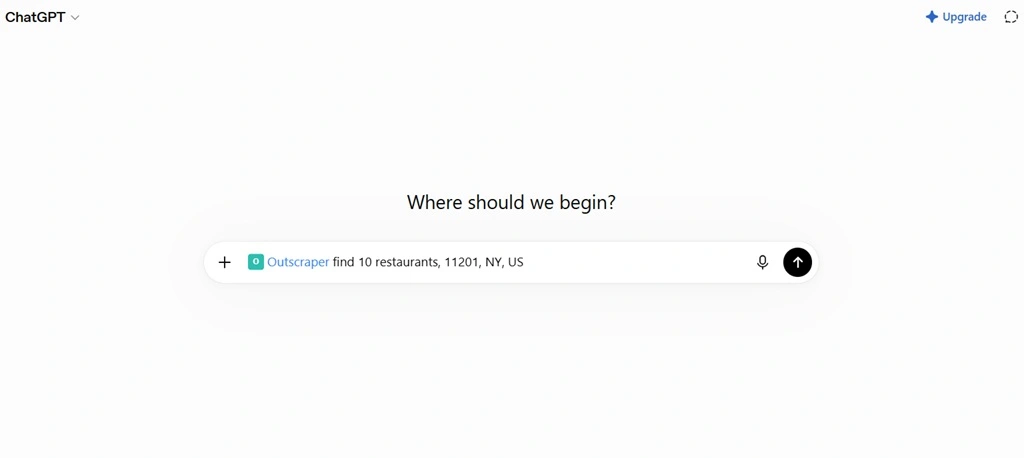
For the test, I connected Outscraper inside ChatGPT and used it to pull local business records.
The first prompt was simple:
@Outscraper find 10 restaurants, 11201, NY, US
I chose a specific category and location because broad prompts usually create weak output.
I did not ask:
“Find me good leads.”
That is too vague.
I gave the workflow three clear inputs:
- business category: restaurants
- location: 11201, NY, US
- output size: 10 leads
That made the test easier to judge.
What the test returned
The result came back as a structured lead table.
It included fields like:
- razón social
- business type
- rating
- número de reseñas
- número de teléfono
The test returned local restaurant records around 11201, Brooklyn, NY.

What surprised me
The useful part was not only the list.
The useful part was what ChatGPT could do after the list existed.
Once I gave it real business records, it helped compare the records, explain the signals, and prepare outreach angles.
A restaurant with 2,520 reviews gives a different signal from a restaurant with 127 reviews.
A restaurant with a 3.9 rating and 907 reviews should be reviewed differently from one with a 4.8 rating and 191 reviews.
That does not mean one business is automatically a lead.
It means ChatGPT can help identify which records deserve human review first.
That is where ChatGPT worked best.
It did not replace fresh lead data.
It helped interpret fresh lead data.
The Follow-Up Prompt That Made the Data Useful
The first prompt pulled the records.
The second prompt turned the records into a qualification workflow.
This is the prompt I would use after getting the Outscraper table:
Review these restaurant leads from 11201, Brooklyn, NY. Score each business as a possible local lead using only the data provided.
Check:
- business type
- rating
- número de reseñas
- phone availability
- possible customer experience signal
- whether the business needs human review
Return:
- razón social
- lead score from 1 to 10
- strongest visible signal
- why it matters
- possible outreach angle
- human review note
Rules:
- Do not invent missing facts.
- Do not claim the restaurant needs help.
- Do not write a full sales email yet.
- Only suggest which records are worth reviewing first.
This prompt matters because it keeps ChatGPT grounded.
It is not allowed to invent revenue, team size, ownership, or hidden pain points.
It can only work from the data provided.
That is the way I would use ChatGPT for AI lead generation.
Not as a magic list builder.
As a scoring and reasoning layer.
ChatGPT works better when it has real business records to review. Use Outscraper to collect business names, categories, websites, phone numbers, ratings, reviews, and locations first. Then use ChatGPT to score the records and prepare outreach angles for human review. code required
ChatGPT Is Strong at Lead Qualification
The strongest part of ChatGPT was lead qualification.
Not final qualification.
First-pass qualification.
If I give it structured records, it can group them into review buckets:
- strong fit
- possible fit
- weak fit
- missing key data
- needs manual review
That helps because raw lead lists are usually messy.
A spreadsheet can show names, ratings, and phone numbers.
ChatGPT can explain which records look more relevant to a specific offer.
For example, if the offer is reputation management, review count and rating become more important.
If the offer is web design, website availability becomes more important.
If the offer is missed-call follow-up, phone visibility and appointment-based categories become more important.
The same data can support different campaigns.
The scoring logic changes based on the offer.
That is where ChatGPT helps.
It does not replace the data.
It helps interpret the data.
ChatGPT Is Useful for Outreach Angles
ChatGPT can write better outreach drafts than most generic cold email templates.
But only when the input is specific.
A weak prompt is:
“Write a cold email for this restaurant.”
That usually gives a generic email.
A stronger prompt is:
“Write a short outreach angle for a restaurant with high review volume, a visible phone number, and a rating below 4.0. Use only the visible data. Do not claim the restaurant needs help. Keep it under 80 words and mark it for human review.”
That is much better.
The message is based on visible signals.
It does not pretend to know private business problems.
It does not invent urgency.
It does not claim deep research.
That is the difference between useful AI outreach and fake personalization.
ChatGPT turns lead data into language.
It should not invent the lead data.
Where ChatGPT Quietly Failed
This is the part most AI lead generation advice hides.
ChatGPT fails when you treat it like a live verified prospect database.
If you type:
“Find me 50 qualified leads in fintech.”
It may give you a clean-looking answer.
It may format the output into a table.
It may sound confident.
But that does not mean the companies are current, reachable, active, or verified.
This is where the risk starts.
ChatGPT can guess company details.
It can mix old information with assumptions.
It can create descriptions that sound real but are not checked.
It can produce a lead list with no verified contact path.
It can miss whether a business is closed, moved, renamed, or no longer relevant.
That is not AI lead generation.
That is a writing assistant filling a data gap.
The Real Cost of Asking ChatGPT to Work Without Fresh Data
A lot of people blame the prompt when ChatGPT gives weak lead generation output.
Sometimes the prompt is the problem.
But in my test, the bigger issue was data.
If ChatGPT does not have fresh records, it has nothing reliable to qualify.
A better prompt can improve structure.
It cannot magically create verified phone numbers, websites, ratings, categories, review counts, and business status.
That is why the “perfect prompt” idea breaks.
People ask ChatGPT to do the entire workflow:
1. Find the leads
2. Verify the leads
3. Score the leads
4. Write the outreach
5. Prepare the follow-up
But ChatGPT is strongest in the middle of the workflow.
It needs the lead data first.
Without fresh data, the damage shows up fast.
Sales teams waste time cleaning bad records.
They check whether the business exists.
They check if the phone number works.
They check if the website is real.
They check if the category matches the offer.
Personalization also becomes fake.
A message can sound specific but still be wrong.
That is worse than a generic message because it shows the prospect you did not actually check the facts.
Then the team loses trust in automation.
One bad AI-generated list can make people stop using the workflow entirely.
Finally, the pipeline never materializes.
The demo looks impressive, but the campaign does not produce reliable opportunities.
That is why fresh data matters.
AI does not fix bad inputs.
It amplifies them.
The Actual Fix: ChatGPT Plus Outscraper
The fix was not to stop using ChatGPT.
The fix was to stop asking ChatGPT to be the data source.
That is where Outscraper fits. The El Scraping de Google Maps gives ChatGPT structured business records to score, instead of forcing it to guess from a blank prompt.
Outscraper gives the workflow fresh business data.
ChatGPT gives the workflow scoring, grouping, and outreach reasoning.
Those are different jobs.
In my test, Outscraper brought back restaurant records from Google Maps.
ChatGPT made those records easier to review.
The workflow became:
Outscraper pulls the local business records.
ChatGPT scores the visible lead signals.
A human reviews the strongest records.
Only then does outreach get written.
That is a complete AI lead generation workflow because each layer has a clear job.
Data first.
AI reasoning second.
Human review third.

Use Outscraper to collect fresh business data first. Then let ChatGPT score the leads, group the strongest records, and prepare outreach angles from real data.
The Workflow I Would Use After the Test
After the first restaurant test, I would not contact all 10 businesses immediately.
That is not how I would use AI lead generation.
The better workflow is to use Outscraper to pull the business data, use ChatGPT to score the visible signals, and then review the strongest records before writing outreach.
Step 1: Choose one ICP
Do not start with a broad market.
Start with one niche and one location.
Examples:
- restaurants in Brooklyn
- dental clinics in Austin
- med spas in Miami
- roofing companies in Phoenix
- gyms in Dallas
- accountants in Denver
- law firms in Chicago
The narrower the first test, the easier it is to judge the output.
Step 2: Pull fresh business data
Use Outscraper to collect structured business records.
For a local lead generation workflow, useful fields include:
- razón social
- category
- sitio web
- número de teléfono
- rating
- número de reseñas
- dirección
- city
- situación empresarial
- Google Maps URL
These are the fields ChatGPT needs before it can score anything properly.
This is the part that turns a simple prompt into a local lead generation workflow because the records now have fields ChatGPT can score.
Step 3: Review the raw list
Before asking ChatGPT to write outreach, review the raw data.
Check:
- Are the businesses in the correct niche?
- Are they in the right location?
- Do they have phone numbers?
- Do they have websites?
- Are they active?
- Do ratings and review counts show enough signal?
- Are there duplicates?
This prevents bad data from becoming bad outreach.
Step 4: Ask ChatGPT to score the leads
Use this prompt:
Review these local business records for AI lead generation. Score each business using only the data provided.
Check:
- category fit
- disponibilidad del sitio web
- phone availability
- rating
- número de reseñas
- situación empresarial
- visible outreach angle
Return:
- razón social
- lead score
- strongest signal
- weakest signal
- why it matters
- possible outreach angle
- human review note
Rules:
- Do not invent missing facts.
- Do not claim the business needs help.
- Do not write a full email yet.
- Only identify records worth reviewing first.
This keeps ChatGPT grounded in the data.
Step 5: Draft outreach only for reviewed leads
After scoring, pick the strongest records.
Then ask ChatGPT for outreach angles.
Use this prompt:
Write a short outreach draft for this reviewed lead. Use only the visible signals provided. Keep it under 90 words. Do not invent facts. Do not claim deep research. End with a soft question. Mark the draft as needing human review before sending.
That prompt prevents the message from becoming too aggressive or fake-personalized.
Step 6: Human review before sending
This part is not optional.
A human should check:
- Is the business still active?
- Does the offer match the business category?
- Is the contact path valid?
- Is the message based only on visible data?
- Does the outreach sound helpful?
- Is the reason for contacting them clear?
ChatGPT can prepare the work.
A person should approve the outreach.
How I would turn the restaurant test into a campaign
The first test returned restaurant records in 11201.
If I were turning that into a campaign, I would group them before writing any message.
Possible review buckets:
- high review volume restaurants
- restaurants below 4.2 rating
- restaurants with visible phone numbers
- restaurants with strong category fit
- restaurants that need website review
- restaurants worth manual check
Then I would choose the offer.
If the offer is reputation management, I would review businesses with high review volume and lower ratings.
If the offer is website improvement, I would check which restaurants have missing or weak websites.
If the offer is missed-call follow-up, I would prioritize businesses with phone numbers and enough customer activity.
If the offer is local SEO, I would review category fit, review count, rating, and profile completeness.
That is how one lead list becomes useful for different campaigns.
The data stays the same.
The scoring logic changes based on the offer.
Where Outscraper Fits and Where ChatGPT Should Stop
Outscraper is the data layer.
ChatGPT is the reasoning layer.
Those roles should stay separate.
Utiliza el El Scraping de Google Maps when you want to collect local business records with names, categories, websites, phone numbers, ratings, reviews, and locations.
Usar local lead generation when the goal is to turn those records into a prospecting workflow.
Usar extract contacts from Google Maps when you need more complete contact paths before outreach.
Utiliza el Google Maps API when you want to connect the workflow into a CRM, dashboard, backend process, or repeatable lead scoring system.
The workflow is simple:
- Fresh lead data first.
- ChatGPT scoring second.
- Human review third.
- Outreach last.
That is the version of AI lead generation I trust.
Where ChatGPT should stop
I would not use ChatGPT to invent lead lists.
I would not trust it to verify company facts without data.
I would not let it send outreach automatically.
I would not let it write messages based on guessed revenue, guessed headcount, or guessed pain points.
I would not use it as a replacement for fresh prospect data.
That is where most AI lead generation advice becomes risky.
ChatGPT is good at reasoning from information.
It is not a substitute for verified inputs.
Preguntas frecuentes
Preguntas y respuestas más frecuentes
ChatGPT can help qualify leads when you give it structured business data. It can score records, group prospects, and explain visible signals. But the final qualification should still be reviewed by a person.
Not reliably. ChatGPT can suggest lead criteria and outreach angles, but it should not be treated as a live verified lead database. It needs fresh business data before it can support a serious AI lead generation workflow.
It works best with fields like business name, category, website, phone number, rating, review count, location, business status, and the offer being sold.
It cannot safely verify every company fact, maintain a large prospect list across a full campaign, pull fresh contacts without connected tools, or approve outreach without human review.
Pick one niche, choose one location, collect fresh business data with Outscraper, and use ChatGPT to score the leads before writing outreach.