目录
引言
Lead generation is facing challenges that can hinder a business’s growth. Traditional methods often rely on outdated techniques such as cold calling, networking events, and purchasing lists. These approaches can be time-consuming, labor-intensive, and often yield low-quality leads. Businesses frequently find themselves investing significant resources, both time and money, into strategies that do not deliver the desired results.
Moreover, the landscape of consumer behavior has undergone a dramatic shift. Potential customers are now more informed and selective, making it increasingly difficult for businesses to capture their attention. The inefficiencies of traditional lead generation can 导致 wasted budgets and missed opportunities, ultimately affecting the bottom line.
This article explains how Outscraper uses advanced data scraping technology to gather high-quality leads from various online sources. This approach not only saves time but also enhances the quality of leads generated, ultimately improving ROI.
Understanding Lead Generation
Lead generation refers to the process of identifying and attracting potential customers (leads) who have shown interest in a product or service. This process can be achieved through various marketing strategies, including content marketing, social media engagement, email campaigns, and more. The primary goal is to convert these leads into paying customers by nurturing them through the sales funnel.
Types of Leads
- Marketing Qualified Leads (MQLs): These are leads that have engaged with your marketing efforts but are not yet ready to make a purchase. Around 31% are converted through these channels. They may have downloaded a resource, subscribed to a newsletter, or engaged with your content.
- Sales Qualified Leads (SQLs): These leads have shown a higher level of interest and are considered more likely to convert into customers. Typically, that is 3% conversion rate, which translates to customers who responded and took action. They may have requested a demo, filled out a contact form, or expressed a clear intent to buy.
- Product Qualified Leads (PQLs): These leads have used your product and demonstrated interest in upgrading or purchasing additional features. They are often generated through free trials or freemium models.
Inbound Leads (Customer Initiated)
Inbound leads are potential customers who initiate contact with a business, typically as a result of engaging with content or marketing efforts that attract them. These leads often come through channels such as websites, social media, blogs, and email marketing.
Characteristics
- Interest-Driven: Inbound leads have shown interest in a product or service, often by downloading a resource, signing up for a newsletter, or engaging with content.
- Higher Intent: These leads are usually further along in the buying process, as they have actively sought out information.
- 经济高效: Inbound marketing often requires less financial investment compared to outbound methods, as it relies on organic traffic and content marketing.
- Longer Nurturing Process: 虽然 inbound leads may be more qualified, they often require a longer nurturing process to convert into customers.
Types of Inbound Leads
- Content Downloads: Leads generated through whitepapers, eBooks, or case studies.
- Webinar Registrations: Individuals who sign up for webinars or online events.
- Newsletter Subscribers: Users who opt-in to receive regular updates and information.
- Social Media Engagement: Leads who interact with a brand’s posts or ads on social platforms.
Outbound Leads (Company Initiated)
Outbound leads are potential customers that a business reaches out to 直接, often through proactive marketing efforts. This approach typically involves cold calling, email outreach, and advertising.
Characteristics
- Proactive Approach: Outbound marketing involves actively seeking out potential customers rather than waiting for them to come to you.
- Lower Intent: Outbound leads may not have expressed interest in a product or service, making them less qualified than inbound leads.
- Higher Costs: Outbound strategies often require significant investment in advertising, sales teams, and outreach efforts.
- Faster Results: Outbound marketing can yield quicker results, as businesses can directly target specific demographics.
Types of Outbound Leads
- Cold Calls: Leads generated through unsolicited phone calls to potential customers.
- 电子邮件营销活动: Outreach emails sent to a list of potential customers who have not previously engaged with the brand.
- Direct Mail: Physical marketing materials sent to potential customers’ addresses.
- Paid Advertising: Leads generated through pay-per-click (PPC) ads or display ads targeting specific audiences.
Important Note: Inbound leads typically begin as Marketing Qualified Leads (MQLs) (content downloads, demo requests) or Product Qualified Leads (PQLs) (free trial users). They are nurtured by marketing until they demonstrate high intent, at which point they become Sales Qualified Leads (SQLs). Outbound leads are usually classified directly as SQLs (prospecting) or qualified against an ICP first.
Traditional Lead Generation
Traditional lead generation refers to the processes and strategies that have been employed over the years to identify and attract potential customers. Unlike digital lead generation, which relies heavily on online platforms and technologies, traditional methods often involve face-to-face interactions, print media, and direct outreach. Despite the rise of digital marketing, traditional lead generation remains a vital component of many businesses’ overall marketing strategies.
Key Strategies in Traditional Lead Generation
1. Networking
Networking is one of the oldest forms of lead generation. It involves building relationships with individuals and businesses that can lead to referrals and potential sales. This can be done through:
- Industry Events: Attending conferences, trade shows, and seminars to meet potential clients and partners.
- Local Business Groups: Joining local chambers of commerce or business associations to connect with other professionals.
2. Cold Calling
Cold calling involves reaching out to potential customers via phone without prior contact. While often viewed as challenging, it can be effective when done correctly. Key points to consider include:
- Research: Understanding the target audience and tailoring the pitch accordingly.
- Persistence: Following up with leads who may not respond initially.
3. Direct Mail
Direct mail campaigns involve sending physical promotional materials, such as brochures or postcards, to potential customers. This method can be highly targeted and personalized. Important aspects include:
- Segmentation: Identifying specific demographics or geographic areas to target.
- Compelling Offers: Including special promotions or discounts to entice recipients.
4. Print Advertising
Print advertising includes placing ads in newspapers, magazines, and other publications. This method can reach a broad audience and is particularly effective for local businesses. Considerations include:
- Ad Placement: Choosing the right publications that align with the target audience.
- Clear Messaging: Ensuring the ad communicates the value proposition 有效地.
5. Referrals
Referrals from satisfied customers can be one of the most powerful lead generation tools. Encouraging existing customers to refer new clients can be achieved through:
- Incentives: Offering discounts or rewards for successful referrals.
- Building Relationships: Maintaining strong customer relationships to encourage word-of-mouth marketing.
优点
- Personal Touch: Direct interaction can build relationships and trust.
- Targeted Approach: Ability to tailor messages to specific audiences.
- Established Methods: Many businesses are familiar with these techniques.
缺点
- Time-Consuming: Requires significant 时间 and effort to generate leads.
- High Costs: Expenses can accumulate quickly, especially for events and purchased lists.
- Variable Quality: The quality of leads can be inconsistent, leading to wasted resources.
Outscraper As Lead Generation Tool
Outscraper is a data scraping tool that automates the process of gathering leads from various online sources, including social media, business directories, and review sites. It allows businesses to extract valuable information quickly and efficiently.
优点
- 速度与效率: Automates data collection, saving time and resources.
- 经济高效: Lower operational costs compared to traditional methods.
- 可扩展性: Easily scales to gather large volumes of data as needed.
- Data Accuracy: Provides up-to-date information, reducing the risk of outdated leads.
缺点
- Less Personal Interaction: Lacks the personal touch of traditional methods.
- Data Compliance: Must ensure compliance with data protection regulations. Though there are API integrations that bypass such data restrictions, it is still encouraged to scrape data responsibly.
Lead Generation Workflow Using Outscraper
A clear workflow improves results and avoids wasted data.
Step 1: Define Ideal Customer Profile
Begin by examining your existing customer base. Identify the customers who are most satisfied with your product or service 和 those who generate the most revenue. Look for common traits among these customers, such as:
- Demographics: Age, gender, income level, education, and location.
- 企业统计学 (for B2B): Company size, industry, revenue, and location.
- Behavioral Traits: Purchase frequency, average order value, and engagement levels.
Step 2: Use Filters to Extract Data
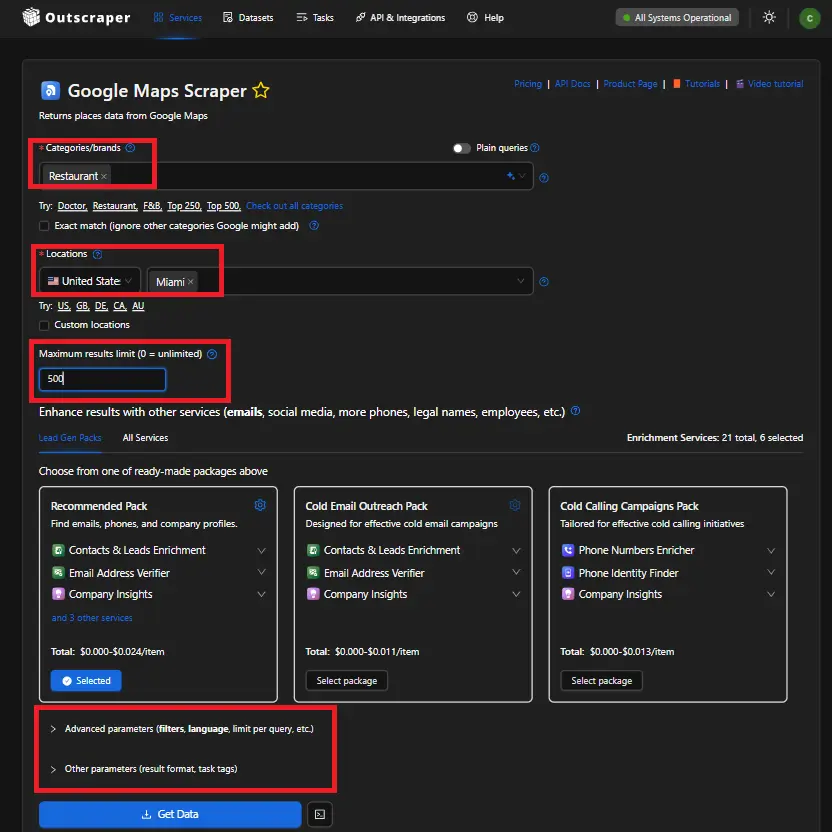
After defining your ICP’s, use Outscraper (Google Maps Scraper) and use the available filters. It consists of categories/brands, location, maximum results, advanced parameters, etc.
第 3 步:添加增强内容
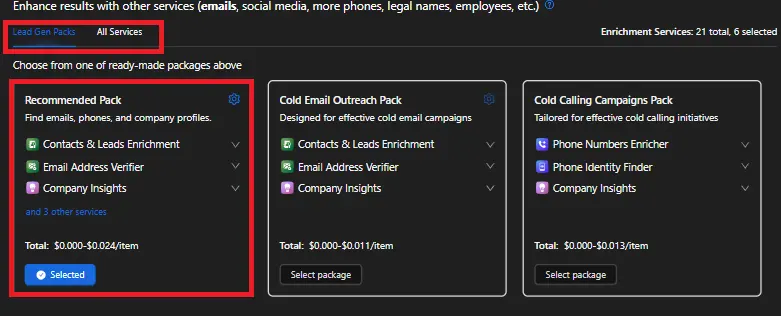
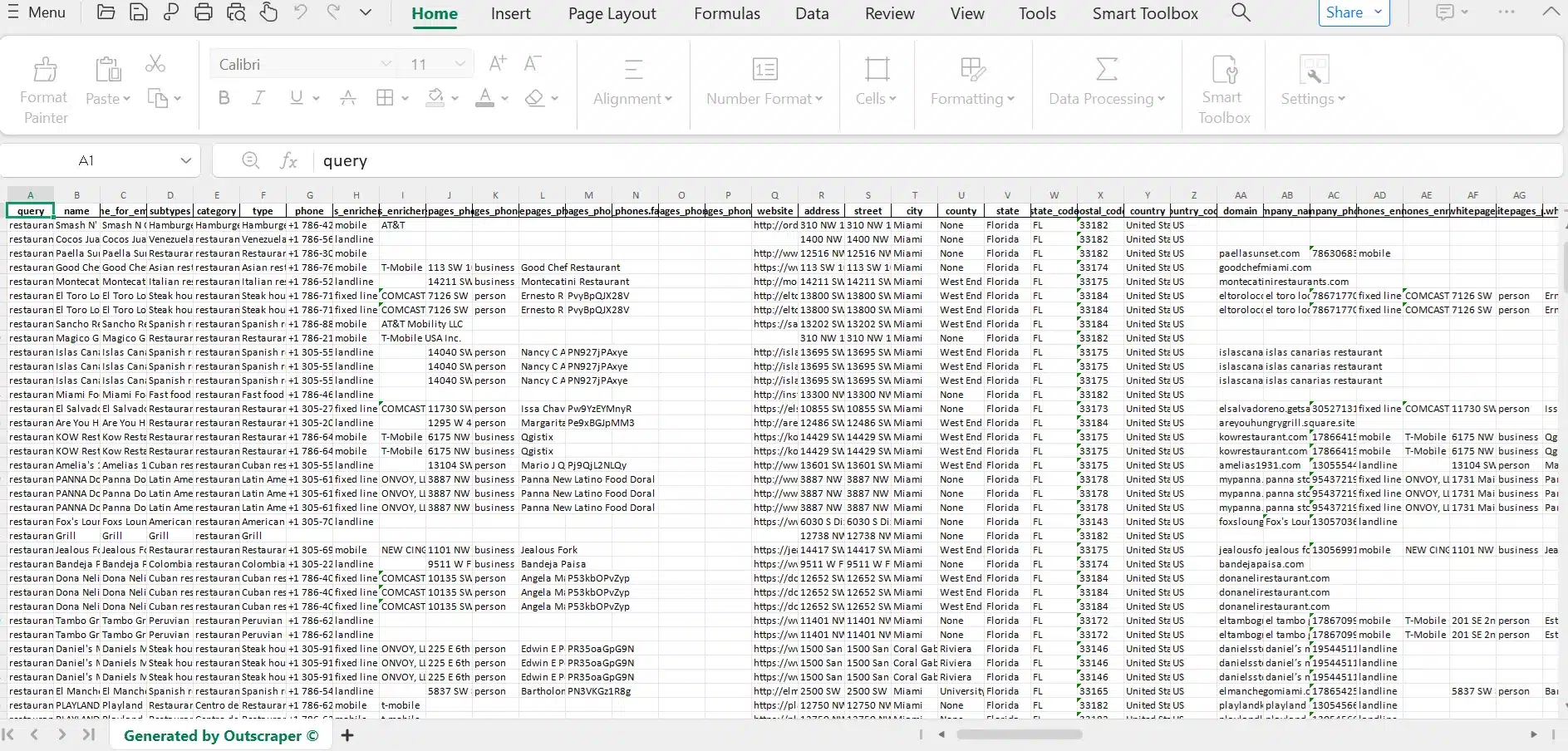
Add enrichment, which is packaged depending on customers’ needs. It is one click away to include enrichment on the data extraction tasks. It adds value to the database, usable for actionable insights and strategic planning for businesses.
Step 4: Validate Results
这是 重要 到 检查 whether the 数据 extracted is satisfactory for what the customer needs. Whether to validate emails, check reviews, check valid contact details, and more.
ROI Analysis
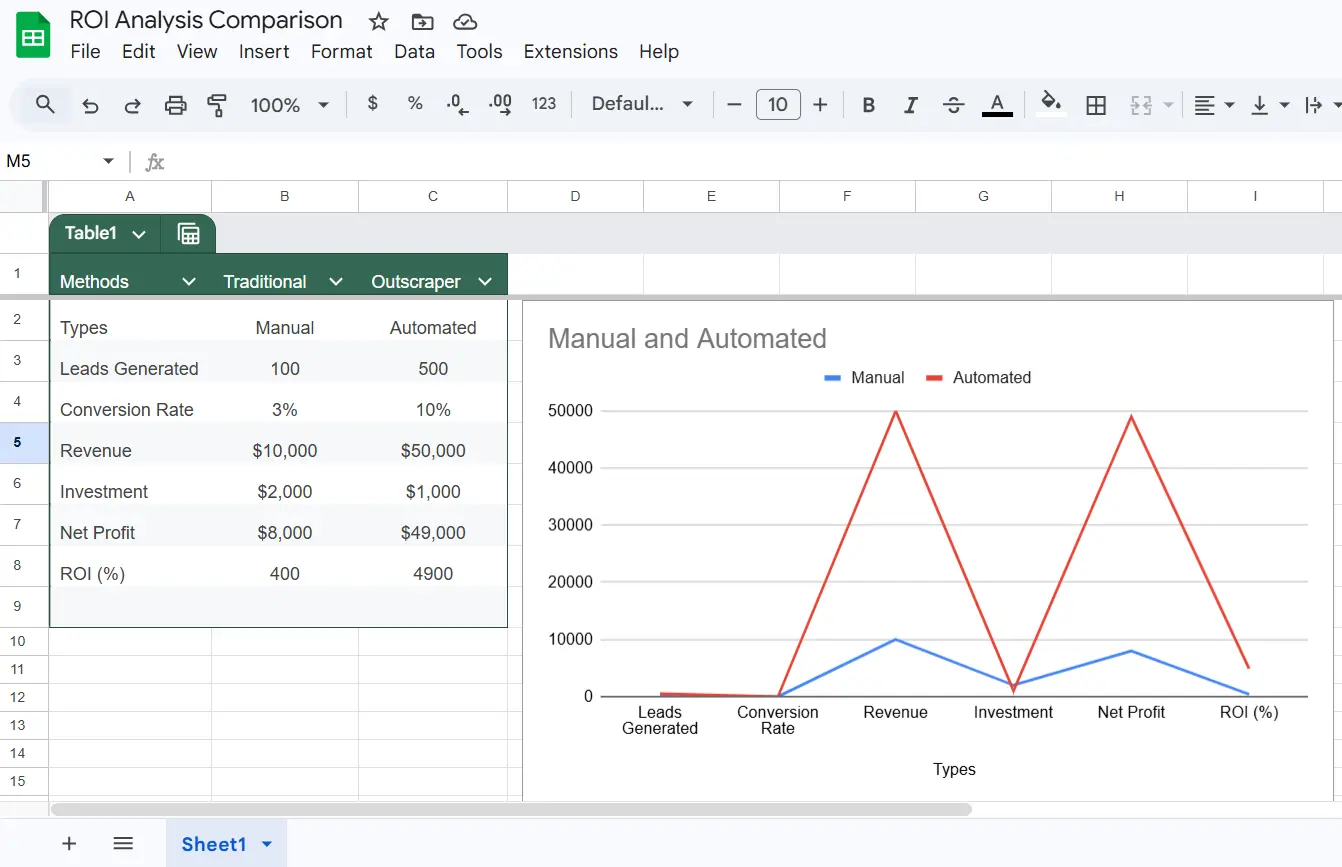
ROI Analysis refers to how lead generation works in both traditional and Outscraper as a medium of data extraction. Below is the cost comparison of the two ways to generate leads:
Cost Comparison
- Traditional Lead Generation Costs:
- Cold Calling: $500 – $2,000 per month (depending on team size)
- Networking Events: $1,000 – $5,000 per event
- Email Marketing: $200 – $1,000 per campaign
- Purchased Leads: $0.50 – $5.00 per lead
- Outscraper Costs:
- Pay-as-you-go Pricing: The cost is dependent on 该 usage (e.g., a $1000 as a top-up amount for data scraping), which covers a substantial amount of enriched data 的 potential leads.
- Additional Costs: Minimal, primarily related to data enrichment and processing.
Revenue Generation
ROI Calculation
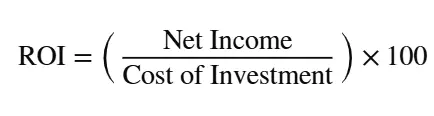
To calculate ROI, we can use the formula:
Sample Size:
Traditional Lead Generation:
- Total Investment: $2,000 (monthly costs)
- Leads Generated: 100
- Conversion Rate: 3%
- Revenue from Sales: $10,000
- Net Profit: $10,000 – $2,000 = $8,000
- ROI: (8,000/2,000) x 100 = 400%
- Outscraper:
- Total Investment: $1000 (Pay-as-you-go pricing)
- Leads Generated: 500
- Conversion Rate: 10%
- Revenue from Sales: $50,000
- Net Profit: $50,000 – $1000 = $49,000
- ROI: (49,900/100) x 100 = 4900%
Note: These figures 使用 a controlled scenario to show cost efficiency. Actual results depend on targeting, messaging, and the quality of execution.
When Traditional Methods Still Work
Use traditional lead generation when:
- You need deep personalization per lead
- Your market is small and relationship-driven
- Data is not publicly available online
Example: Enterprise B2B deals.
When Outscraper Delivers Strong ROI
Use Outscraper when:
- You target local businesses
- You run cold email or cold calling campaigns
- You need volume and speed
- You rely on data-driven segmentation
Supporting Evidence to Include
To strengthen credibility, attach:
- Campaign case study
- Include industry, lead volume, cost, and conversion results
- Outreach report
- Include open rate, reply rate, and bounce rate
- Sample dataset
- Show extracted fields such as business name, email, and category
- Benchmark references
- Use industry reports for average conversion rates
Traditional lead generation depends on manual effort and fixed costs. It performs well in relationship-driven environments but struggles to scale.
Outscraper improves efficiency through structured data extraction and targeted outreach. It reduces cost per lead and increases reach when paired with validation and clear targeting.
The difference in ROI comes from three factors:
- Lower acquisition cost
- Higher lead volume
- Better targeting precision
Execution quality determines final results. Poor targeting or unverified data reduces performance regardless of method.
总结
Traditional lead generation relies on manual processes such as cold calling, networking, and direct outreach. These methods require a high time and cost investment, and the quality of the lead often varies. Conversion rates stay low due to limited reach and inconsistent targeting. While these methods still work in relationship-driven markets or small segments, they do not scale efficiently.
Outscraper changes the process through automated data extraction and structured lead generation. It collects large volumes of targeted data, improves accuracy, and reduces time spent on manual research. Lower costs combined with higher lead volume and better targeting improve conversion rates.
The ROI comparison shows a clear difference. Traditional methods generate lower returns due to higher costs and lower conversion rates. It is more beneficial to use Outscraper, which produces higher returns by reducing cost per lead and increasing qualified opportunities. The difference in ROI comes from speed, scale, and data quality.
常见问题
最常见的问题和答案
在数字渠道占据主导地位之前,传统的销售线索挖掘涉及外向营销策略,以识别和吸引潜在客户。它侧重于直接的个人外联活动,以建立客户兴趣并获取详细联系信息以便跟进。.
Outscraper 潜在客户生成利用 Outscraper 平台的搜索工具(主要是谷歌地图数据搜索器)从公共资源中自动提取商业潜在客户。它通过提取姓名、地址、电话号码、电子邮件、网站和社交资料等详细信息,锁定 B2B 潜在客户。
ROI analysis evaluates the profitability of an investment by comparing its net returns to its costs, expressed as a percentage. It’s a key metric for decisions in marketing, projects, or tools like Outscraper’s lead generation.
冷电子邮件推广是指主动向没有任何关系的潜在客户发送个性化电子邮件,以引发业务对话。.
经过验证的联系名单是包含客户或潜在客户联系信息(如电子邮件、电话号码和公司详情)的数据库,这些信息都经过验证过程,以确保准确性、可送达性和相关性。.
声誉管理涉及监测、影响和维护个人、企业或品牌的正面公众形象,尤其是在网上。.
情感分析可确定文本数据背后的情感基调,将其分为积极、消极或中性。企业将其应用于客户反馈、社交媒体和评论,以衡量意见并发现趋势