Зміст
Hotel price scraping can be lawful in some circumstances, but there is no universal rule that makes every hotel-data scraping workflow legal.
For travel businesses asking whether hotel price scraping is legal, the answer depends on several factors: where the data comes from, whether it is publicly accessible, how the website is accessed, what the website terms say, which jurisdiction applies, what information is collected, and how that information will be used.
The better question is therefore not simply, “Can we scrape this hotel price?”
It is:
Has this specific hotel-price data workflow been designed around the legal, contractual, technical, and data-use requirements that apply to it?
This guide explains the main compliance questions travel businesses should evaluate before collecting hotel pricing data at scale.
Quick Answer: Is Hotel Price Scraping Legal?
Hotel price scraping can be lawful in some circumstances, but compliance depends on the source, method of access, website terms, jurisdiction, privacy requirements, technical restrictions, and how the resulting data is used. Public availability is relevant, but it does not automatically make every method of collection or reuse permissible.
Is Hotel Price Scraping Legal?
There is no single global yes-or-no answer.
A travel business may collect publicly displayed room prices for competitive-rate monitoring, while another workflow may involve login-gated rates, personal information, protected hotel descriptions, photographs, or automated access that conflicts with contractual or technical restrictions.
Those situations should not be treated as equivalent.
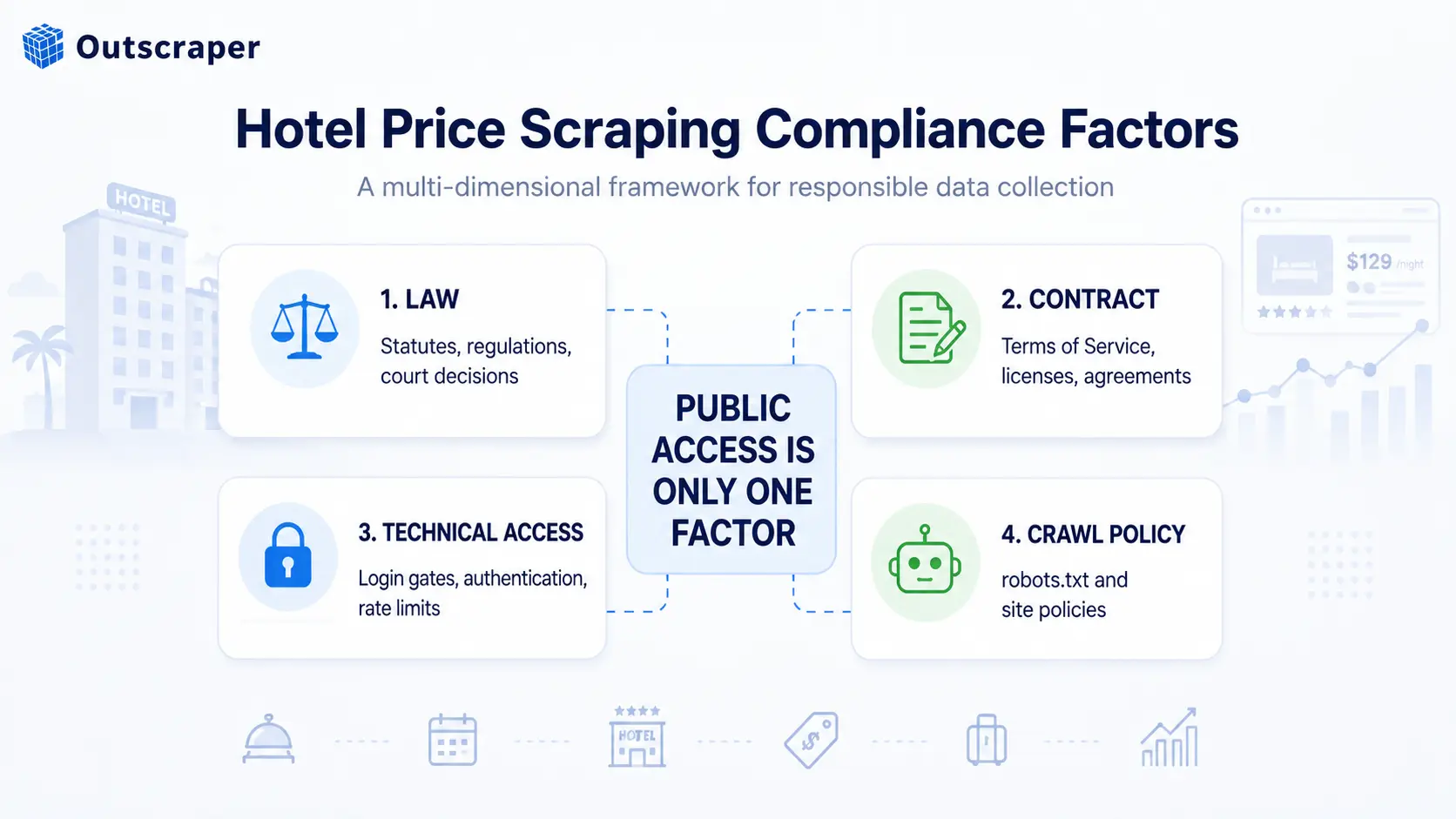
A useful way to evaluate the issue is to separate four different types of restrictions.
Legal Restrictions
A statute, regulation, privacy requirement, copyright rule, database right, or other applicable law may affect how information can be accessed, processed, stored, or reused.
In the United States, the Computer Fraud and Abuse Act can become relevant when automated access crosses authorization or technical access boundaries.
The U.S. Department of Justice provides official guidance on CFAA enforcement and distinguishes certain computer-access issues from situations involving only contractual restrictions.
However, that guidance should not be interpreted as blanket permission to scrape websites or disregard applicable terms.
Authoritative source:
https://www.justice.gov/jm/jm-9-48000-computer-fraud
Contractual Restrictions
Website Terms of Service, API agreements, licenses, and other contracts can establish conditions governing automated access and reuse.
A contractual restriction is not automatically the same as a criminal-law prohibition.
However, that does not make contract terms irrelevant.
Before collecting hotel data, a travel business should determine what agreements or terms apply to the source and how those conditions affect the intended workflow.
Technical Restrictions
Technical controls may include:
- login requirements
- authentication
- CAPTCHAs
- rate limits
- session controls
- access restrictions
- other systems intended to limit automated access
Trying to bypass those controls can create a materially different risk profile from accessing information that is openly available to ordinary visitors.
Robots.txt and Crawl Policies
A robots.txt file is a machine-readable instruction used by websites to communicate crawling preferences.
It should not be described as a law by itself.
However, it can still represent a technical or policy signal that a responsible data-collection process should consider.
The key distinction is:
Legal prohibition, contractual restriction, technical restriction, and crawl policy are related issues, but they are not automatically the same thing.
That is why the statement “the data is public” is not enough by itself to determine whether a hotel-price scraping workflow is appropriate.
The Main Compliance Risks Travel Businesses Should Check
Hotel-price scraping becomes easier to assess when the workflow is broken into specific questions.
Before implementation, a business should know what information it wants to collect, where that information comes from, how the source will be accessed, and how the resulting dataset will be used.
Terms of Service and Access Restrictions
Start with the source.
Determine whether hotel prices are openly visible without authentication and whether the source imposes contractual restrictions involving automated collection, copying, storage, redistribution, or commercial use.
Public competitor rates and member-only rates should not automatically be treated as the same scenario.
For example, monitoring publicly displayed nightly rates may present a different risk profile from retrieving prices available only after authentication or through restricted membership access.
Privacy and Personal Data
Hotel prices themselves usually describe a commercial offering rather than an individual.
However, broader hotel datasets can sometimes contain names, contact details, reviews, or other information connected to identifiable people.
If personal data is involved, privacy requirements become a separate compliance consideration.
Under the EU General Data Protection Regulation, processing personal data requires an appropriate lawful basis under Article 6 and must comply with other applicable GDPR requirements.
Official EU source:
https://eur-lex.europa.eu/eli/reg/2016/679/
The practical question is:
Does the business actually need every field it plans to collect?
If the purpose is hotel-rate monitoring, collecting unnecessary personal information may add compliance complexity without improving the pricing analysis.
Copyright and Database Rights
Collecting a factual room price is different from copying an entire hotel listing.
The U.S. Copyright Office explains that facts themselves are not protected by copyright, although original expression may be protected.
Official source:
https://www.copyright.gov/help/faq/faq-protect.html
That distinction matters for hotel-data workflows.
Factual fields might include:
- hotel name
- nightly price
- availability
- room type
- місцезнаходження
- property rating
A different set of considerations can arise when a business copies or republishes:
- hotel photographs
- detailed descriptions
- marketing copy
- editorial content
- other expressive material
Database-specific rights can also matter.
Within the European Union, Directive 96/9/EC provides legal protection for databases and includes rules relating to extraction and reutilization.
Official EU source:
https://eur-lex.europa.eu/legal-content/EN/ALL/?uri=CELEX:31996L0009
Therefore, a business should evaluate not only the individual fields being collected but also the scale, structure, and downstream use of the resulting dataset.
Responsible Request Behavior
The data fields are only part of the workflow.
The collection method also matters.
Travel businesses should consider request frequency, server load, rate limits, authentication requirements, retries, concurrency, and whether automated collection is interfering with the source.
A responsible workflow should avoid assuming that more aggressive access automatically produces a better business result.
When Hotel Price Scraping Becomes Higher Risk
Some hotel-data workflows create more compliance questions than others.
The following scenarios show how the risk profile can change.
Public Competitor-Rate Monitoring
Imagine a travel business monitoring publicly visible nightly room rates for selected hotels.
This may present a lower relative risk than accessing restricted information because the prices are available without authentication.
However, the business should still review the applicable terms, automated request behavior, jurisdiction, source policies, and downstream use.
Public accessibility is an important factor, but it does not resolve every compliance question.
Republishing Full Hotel Listings
Now consider a comparison website that collects prices along with hotel photographs, detailed descriptions, marketing copy, and other page content and republishes everything on its own website.
Additional issues may arise because the workflow now involves expressive content, photographs, database rights, licensing questions, and contractual restrictions.
That is materially different from collecting only selected factual pricing fields for internal analysis.
Accessing Member-Only or Gated Rates
Suppose a scraper attempts to collect prices available only after login, membership, authentication, or another restricted access process.
That situation deserves greater scrutiny.
Authorization, access controls, contractual terms, and applicable computer-access rules become more significant.
A workflow should not assume that data can be automatically collected merely because an authorized human user can view it.
Official APIs or Licensed Feeds
A travel company may instead obtain hotel pricing through an authorized API or licensed data feed.
This can provide clearer access rights and more predictable technical access.
However, API and licensing agreements still define how the data may be accessed, displayed, retained, redistributed, or commercially reused.
The lesson is not that one method is automatically legal and another automatically illegal.
Instead, different collection methods create different access rights, operational tradeoffs, and compliance responsibilities.
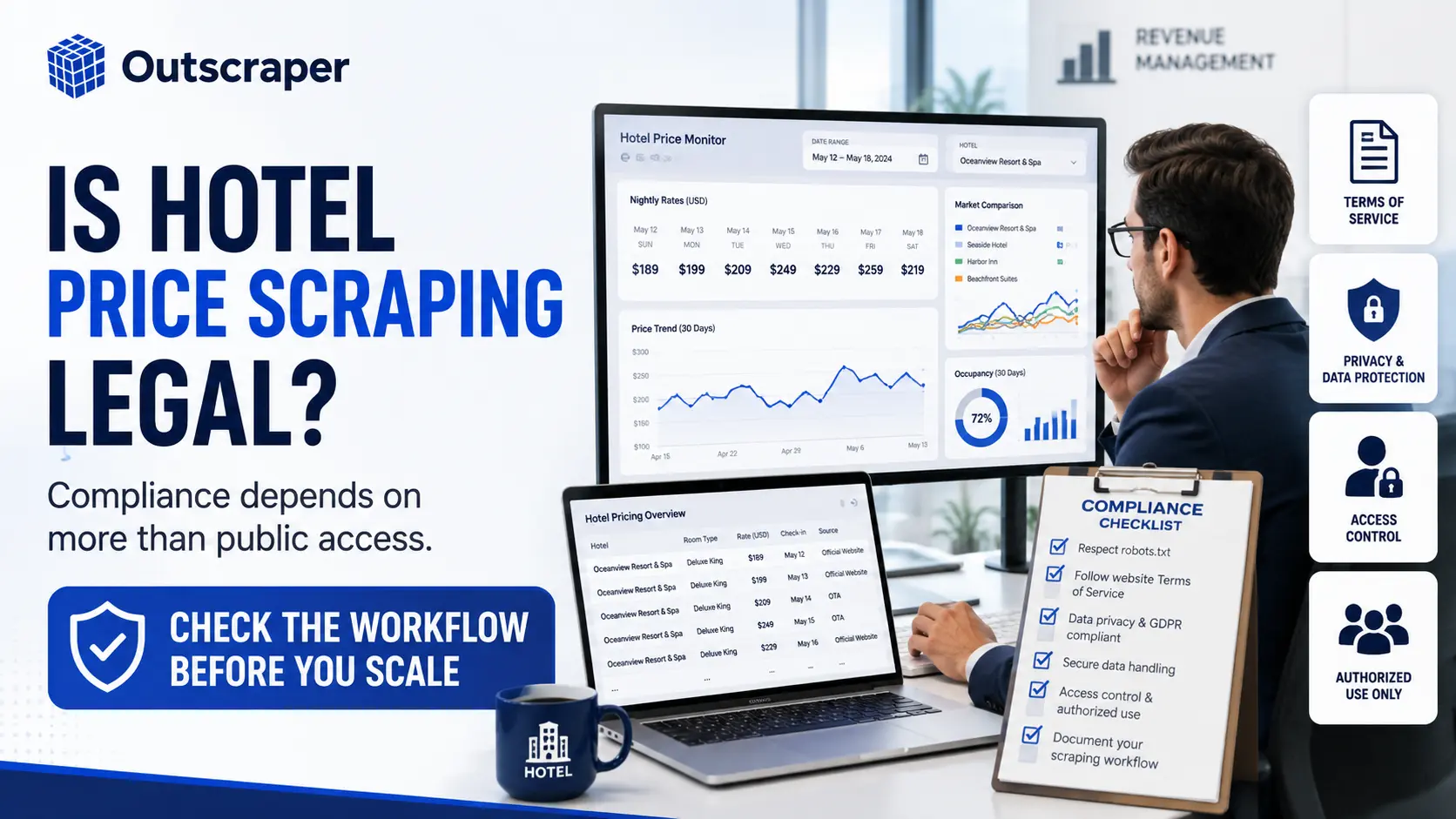
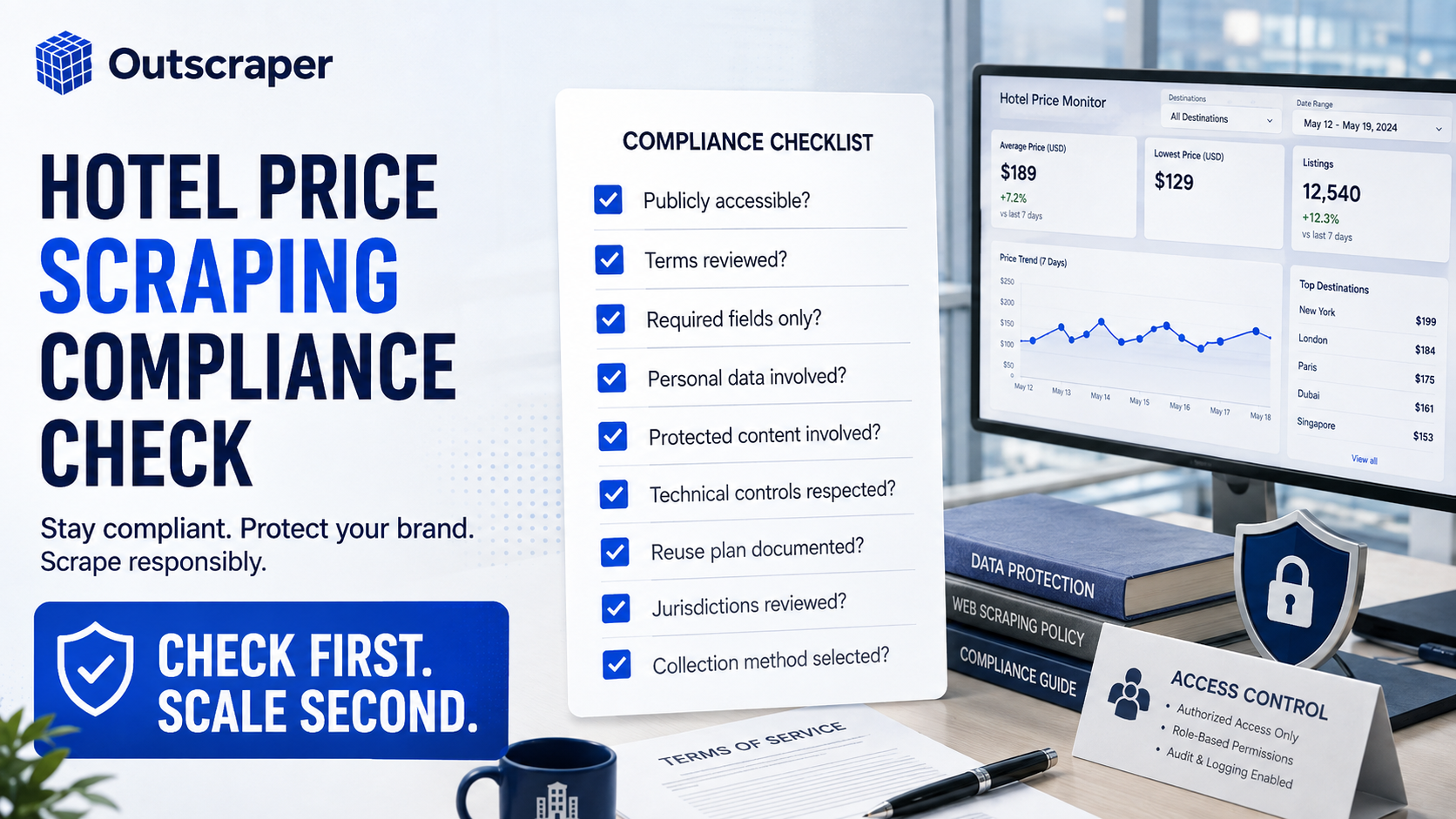
A Compliance Checklist for Hotel Price Scraping
Before starting or scaling a hotel-price scraping workflow, document the answers to these questions:
- Is the pricing data publicly accessible? Determine whether ordinary visitors can view it without authentication or special access.
- Are we bypassing authentication or technical controls? Identify login gates, access restrictions, rate limits, or other barriers.
- What do the website terms say? Review applicable Terms of Service, licenses, API terms, and other agreements.
- What exact fields are we collecting? Separate factual pricing information from photographs, descriptions, personal data, or other content.
- Are we collecting only what is necessary? Limit the dataset to information required for the business objective.
- Does the dataset contain personal information? If so, determine which privacy rules and lawful-processing requirements apply.
- Are we collecting factual prices or protected content? A room rate and an original hotel photograph raise different questions.
- How will the data be stored and reused? Consider retention, analytics, redistribution, publication, resale, and system integrations.
- Will any collected content be republished? Republishing may raise additional copyright, database-right, licensing, or contractual questions.
- Are requests being sent responsibly? Review request volume, frequency, concurrency, retries, and server load.
- Does the source provide an API or licensed feed? An official method may provide clearer access rights for some use cases.
- Which jurisdictions apply? The company, source, hotels, users, and processing systems may exist in different jurisdictions.
- Does the scale or business model justify legal review? Large-scale or legally uncertain workflows may warrant advice from qualified counsel.
A practical internal rule is:
Define the workflow first. Evaluate the compliance requirements second. Scale only after both are understood.
Choosing the Right Hotel Data Collection Method
Once the compliance review is complete, the business can decide how the required hotel-pricing information should be obtained.
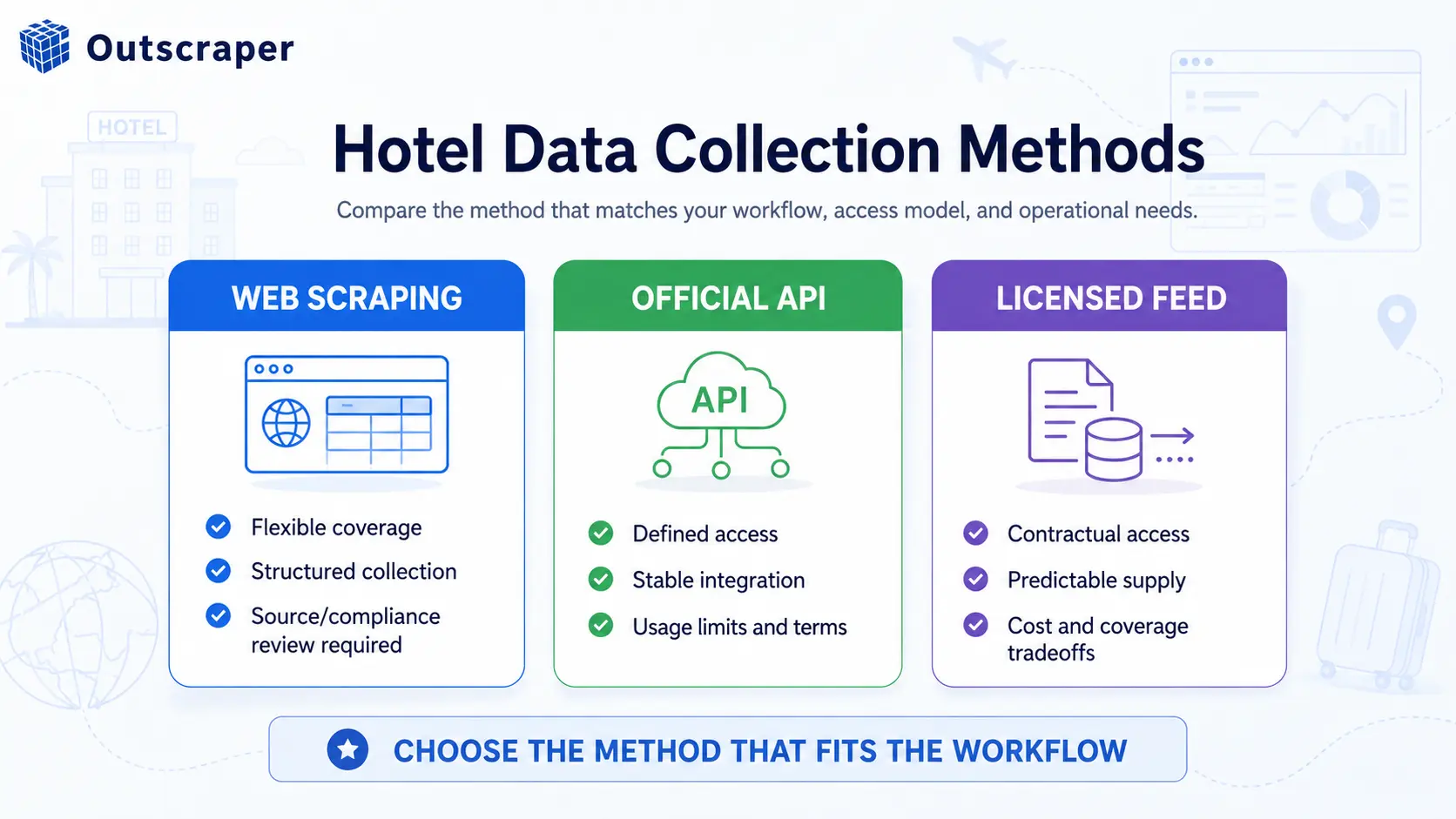
The three common approaches are web scraping, official APIs, and licensed data feeds.
Вишкрібання веб-сторінок
Web scraping can provide flexible collection when a business needs structured information from publicly accessible web sources.
Potential use cases include competitor-rate monitoring, market research, availability analysis, property discovery, and hotel price comparison.
However, the business remains responsible for evaluating the source, access method, contractual terms, applicable law, request behavior, and downstream use.
For a practical implementation example, see Як налаштувати скрайбінг цін на готелі для туристичних афіліатів.
Official APIs
Official APIs provide a defined technical interface for accessing data.
They may offer greater technical stability and clearer access conditions, but they can also impose restrictions involving available fields, request quotas, geographic coverage, permitted use, display requirements, or redistribution.
API terms still need to be reviewed because authorized access does not automatically mean unrestricted reuse.
Licensed Data Feeds
Licensed hotel-data feeds can be useful when a business requires predictable access rights, contractual support, stable availability, or clearly defined commercial reuse rights.
The tradeoff can include higher cost, reduced flexibility, or dependence on the provider’s coverage.
For many travel businesses, the decision comes down to four factors:
coverage, reliability, access rights, and operational flexibility.
Outscraper can fit into the data-collection layer after the business has defined the information it needs and reviewed the relevant compliance requirements.
Travel teams evaluating hotel datasets can explore the Google Hotels Scraper or the Booking.com Hotel Scraper depending on the required source and use case.
Businesses focused on rate-monitoring workflows can also review Hotel Rate Shopping Tools: Enterprise vs Affordable Alternatives.
The collection tool should come after the compliance decision, not before it.
Build the Compliance Check Before You Scale the Scraper
The most useful question is not simply whether hotel price scraping is legal.
A travel business should first define the exact data it needs, identify the source, understand the access conditions, review the applicable terms and legal requirements, and determine how the resulting information will be stored and used.
Only then should the business choose its collection method.
A practical sequence is:
Define the data needed → identify the source → understand access conditions → review terms and applicable rules → choose the collection method → test responsibly → scale
That approach keeps the compliance decision connected to the actual hotel-data workflow instead of relying on broad assumptions about web scraping.
Frequently Asked Questions
Найпоширеніші запитання та відповіді
Hotel price scraping can be lawful in some circumstances, but there is no universal rule. The answer depends on factors such as public accessibility, the method of access, website terms, jurisdiction, technical restrictions, the type of data collected, and how the resulting information is used.
No. Public accessibility is one relevant factor, but it does not automatically resolve contractual, copyright, database-right, technical-access, privacy, or jurisdiction-specific issues.
Accessing login-gated, membership-only, or otherwise restricted pricing can create additional authorization, technical-access, and contractual questions. These workflows should receive more scrutiny than ordinary collection from openly accessible pages.
Facts themselves are generally distinguished from protected original expression under U.S. copyright principles. However, hotel photographs, descriptions, marketing copy, and other expressive material may raise different copyright questions. Database rights may also apply in some jurisdictions.
A robots.txt file is a machine-readable crawl instruction or policy signal. It is not itself a universal law. However, it can still be relevant when designing responsible automated collection.
An authorized API can provide clearer technical access and contractual conditions, but the API’s own terms still control permitted use, storage, display, redistribution, and other activities.
No. A data-collection tool does not determine whether a particular workflow is legally compliant. Businesses should evaluate the source, access conditions, terms, jurisdiction, data type, and intended use for their specific project.
Legal review may be appropriate when a workflow is large-scale, commercially significant, involves restricted access or personal information, spans multiple jurisdictions, republishes source content, or presents uncertainty that could materially affect the business.
Define the hotel pricing data your business needs, evaluate the appropriate collection method, and build a structured workflow only after you understand the source, access conditions, terms, and requirements that apply to your use case.